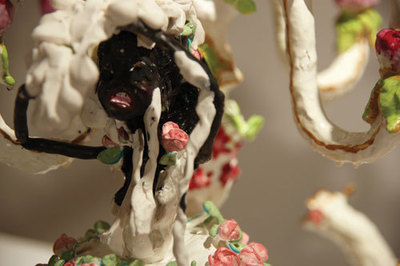
My friend the artist N Pushpamala, has issued a call for artists to boycott a forthcoming show of Indian art, called
Deconstructing India, to be mounted at the Tel Aviv Museum next April. Pushpamala's central point is that the exhibition, and the museum that will host it, serves to legitimise the 'racist and apartheid' policies of Israel.
I don't care overmuch if the show happens or not. It sounds like a replica of a dozen other exhibitions of contemporary Indian art with names like Chalo India, Indian Highway, Indian Summer, India-this, and Indian-that, none of which got rave notices or created any genuine excitement among foreign spectators.
As anybody who reads this blog regularly will know, I'm not a big fan of Israel. I am, however, even less a fan of blanket cultural boycotts. When another friend, the artist Tushar Joag, circulated Pushpamala's mail to a wide group, I responded with the letter quoted below (I've removed a few specific examples I gave):
I don't understand this, frankly. If we start boycotting museum shows because of bad things governments are doing, where will it end?
Why should Indian artists exhibit in China, when the regime there has been responsible for horrendous massacres and continues to deny basic freedom of expression to its citizens?
Why should people exhibit in museums and universities in the United States (almost all of which receive state funding), when the country is responsible for the deaths of 100,000 Iraqi civilians in the past decade and many more in the decade before that?
Why should galleries exhibit at the state-backed Sharjah Biennale and Dubai art fair, when the UAE denies the most basic rights to migrant labour, much of which is sourced from the sub-continent (if you want to speak about apartheid, the UAE is a great example of apartheid written into law)?
Why should we collaborate with artists and curators from Iran and Pakistan despite the terrible record of the governments of those countries in protecting minority rights? Denying minorities equality under the law is very akin to apartheid, isn't it?
Why, in the end, should artists and curators exhibit at the Lalit Kala Akademi and the National Gallery of Modern Art when we know the many kinds of repression unleashed by the Indian state, many of which have been explored and interrogated by artists and activists on this email? Does showing at the Lalit Kala legitimise all the dreadful policies of the Indian governments in Kashmir, the North East, Chattisgarh, Gujarat etc.?
Israel has done terribly by the Palestinians, but associating art institutions and centres of learning, even state funded ones, so closely with state policy is a silly mistake in my opinion, and tokenism of the worst kind as well.I'd hoped a debate would begin about the issue, but received only personal mails from people supporting my position. I presume other mails went out to those proposing the boycott, supporting
their position. Today, Pushpamala forwarded a response to my letter from Lisa Taraki of PACBI (The Palestinian Campaign for the Academic & Cultural Boycott of Israel).
Lisa wrote:
This is a very familiar argument, and this is our usual response:There are indeed plenty of repressive regimes, and some of them are already subject to sanctions. There are also many other regimes that trample on their citizens' rights while enjoying support from world powers such as the USA, the EU, and other centers of power. However, when there is a people's movement, such as the Palestinian BDS movement, that explicitly calls upon conscientious citizens of the world to boycott their oppressor in order to bear pressure to achieve its rights, it is the obligation of those conscientious people, whether in India or in France, to heed the call. If there were a boycott movement in China, Iran, or Pakistan urging conscientious artists and academics, etc. to boycott the major cultural and academic institutions in those countries, then it would be the duty of conscientious artists and academics to respond to the call. The vast majority of Palestinian civil society has adopted the Palestinian BDS Call (http://www.bdsmovement.net/call)Just consider what the reaction of the anti-apartheid movement in South Africa would have been if artists, academics, and sportsmen and sportswomen around the world had refused to support the boycott of the South African state because there were other oppressive regimes the world over. Either boycott all such regimes, or no support for your struggle, they would have said! That would have rightly been considered an abrogation of responsibility, a diversionary tactic. Why is Israel being treated differently? Why the special allowances for Israel? Palestinian civil society is asking artists, academics, and other conscientious people the world over to support its call for BDS. Do we listen to the voice of the oppressed? That is the basic issue.The cultural and academic boycott, targeting the mainstream institutions of the Israeli state (and the Tel Aviv Museum of Art is certainly part of the establishment, as is clear from a review of its website), aims to isolate Israel until Palestinian rights guaranteed by international law are achieved. Pressure on the Israeli state is the only avenue left, in view of the failure of all other measures, from diplomacy to "constructive engagement" to persuasion. And this is my reply to Lisa:
Hi Lisa,
If this is a familiar argument, I'm surprised you have not come up with better answers. But that might be because there ARE no better answers.
You write:
"...when there is a people's movement, such as the Palestinian BDS movement, that explicitly calls upon conscientious citizens of the world to boycott their oppressor in order to bear pressure to achieve its rights, it is the obligation of those conscientious people, whether in India or in France, to heed the call."
There is absolutely no obligation on conscientious citizens anywhere in the world to heed anybody else's call. There are a thousand people's movements across the globe, and many of them issue such boycott calls. The validity of every call has to be determined by individuals rather than result from the sort of obligatory Groupthink you recommend. Just because I consider your boycott call absurd does not make me any less conscientious a citizen than those who choose to obey it.
You write:
"Just consider what the reaction of the anti-apartheid movement in South Africa would have been if artists, academics, and sportsmen and sportswomen around the world had refused to support the boycott of the South African state because there were other oppressive regimes the world over. Either boycott all such regimes, or no support for your struggle, they would have said! That would have rightly been considered an abrogation of responsibility, a diversionary tactic. Why is Israel being treated differently? Why the special allowances for Israel?"
Artists academics and sportsmen joined the boycott of South Africa as part of a worldwide political and economic boycott. The cultural contribution was significant, but nowhere near as significant as political isolation and economic strangulation; without those two components, and the worldwide political consensus that engenders them, cultural boycotts are of little use. You will not be able to give me a single example of a cultural boycott of the kind you propose having produced significant political change anywhere in the world.
Besides, even at the height of the apartheid ban, people all over the world read and admired novels by the likes of Nadine Gordimer and J.M. Coetzee. Their being South African, and continuing to live in South Africa, did not lead to us boycotting their publications. Your movement, on the other hand, insists on boycotting all individuals with Israeli citizenship. How can you decide, on the basis of a website, what the affiliations of curators in Tel Aviv's Museum of Art are? Do you know any of them? Or have you studied their writing and concluded that they support the excesses of the Israeli State? I'm willing to wager you do not and have not.
You write:
"The cultural and academic boycott, targeting the mainstream institutions of the Israeli state (and the Tel Aviv Museum of Art is certainly part of the establishment, as is clear from a review of its website), aims to isolate Israel until Palestinian rights guaranteed by international law are achieved. Pressure on the Israeli state is the only avenue left, in view of the failure of all other measures, from diplomacy to "constructive engagement" to persuasion."
If the Palestinians had adopted a primarily non-violent form of resistance like India did in its struggle against imperialism, or like the American Civil Rights movement did, I have no doubt there would have been a viable Palestinian state in existence by now. Decades of Islamist terrorism failed to shake the Mubarak regime, but a few weeks of widespread non-violent protest brought it down. The Palestinians have kept the option of resorting to violence open even when they have entered negotiations with Israel. The Palestinian public continues to support the targetting of Israeli civilians, and a martyr cult has been fostered in the Occupied Territories. Perhaps Palestinians should look more closely at their own failures down the decades, before speaking of what is "the only avenue left" and of the "failure of all other measures".
regards
Girish
 I dined at the Mayfair Hakkasan two years ago courtesy of Dinesh and Minal Vazirani of Saffronart. It was after a discussion on 'Junctures and Departures: Locating Modern and Contemporary Indian Art' at Saffronart's Bond Street gallery. I recall the food being good though not exceptional. What struck me most about the space was how crowded it was. Also, the waiters going around asking each diner about food allergies.