Showing posts with label politics. Show all posts

Friday, December 14, 2012

This morning's accident


A common morning story. A large Chevrolet is double parked in front of my building, leaving only one lane free for two-way traffic. A Maruti Dzire goes past the Chevy in a hurry, just as a taxi driver backs out of the driveway of the building opposite my home. The taximan, looking out for vehicles coming from his left, doesn’t see the Maruti driving in the right (ie. wrong) lane, and reverses into it. The Maruti is dented, the taxi, an old Premier, unmarked. The Maruti’s driver demands compensation, the taxi driver refuses, suggesting they go to a police station to sort everything out. In India, the person who suffers most in an accident is always a victim, the facts of the case don’t matter. Having seen close-up what happened, I explain to the people gathered below my balcony that the real culprit, the man who had double parked, has driven off. But that doesn’t stop a fight from breaking out.
The driver of the Maruti is Marathi, the taxiwalla from UP. The home state of the men becomes more important than the way the incident played out. A man on a motorcycle taking his young boy to school stops to figure out the language situation, and begins to abuse the taxi driver. Emboldened, the Maruti driver slaps the taxi man, something he’d never do in a one-on-one match up against his tall and well-built antagonist. The cab driver, knowing he’s in the Marathi manoos heartland, does not retaliate. He says, “How will beating me help. I have no money to pay you. Let’s go to the police station”. The man on the motorcycle continues shouting. “Speak in Marathi, motherfucker”, he says to the ‘bhaiyya’, though everybody present understands Hindi perfectly well. His boy shrinks away to the edge of the back seat, on the verge of tears.
The old Shivaji Park civility is not entirely dead. A gentleman in his late fifties intervenes, insisting the shouting and beating stop. A woman calls out from a balcony backing him up. I say again it wasn’t really the taxi driver’s fault. Had there been one or two more aggressive MNS types in the crowd, the safari-clad gentleman would’ve been told to shut up, and the fight would’ve escalated. But the scales happen to be evenly balanced, and the situation clams down. The drivers go off to the police station.
I think of the hundreds of insults that North Indians face in Bombay each day. By now, after years of this treatment, every poor or middle class person from UP and Bihar must feel unwelcome, and sometimes unsafe. The question is: if North Indians stop coming to this city, and if some of those already here leave, will it increase opportunities for Marathis? A Marathi rickshaw owner with cancer doesn’t think so, and his story is instructive. It’s not as if Marathis are actively seeking to drive autos and taxis, and being deprived because of an influx from the north. Protectionist laws and the assault on North Indians have only led to fewer taxis and autos plying, inconveniencing commuters.


Meanwhile, opposite Shiv Sena Bhavan, the largest towers ever built in Dadar are being sheathed in glass. The complex, now called Kohinoor Square, used to be Kohinoor Mills. The 4.8 acre plot was purchased by Raj Thackeray (who later sold his stake at a fat profit) and Unmesh Joshi (son of Shiv Sena leader Manohar Joshi) in 2005 for 421 crore rupees (over 75 million USD). Nobody knows where Thackeray got that kind of money, but as long as he defines enemies for his followers to target, they won’t ask questions; and they won’t understand that, if this city is in many ways unlivable, it isn’t because of northerners coming here to work hard for a living, but because of builders who’ve corrupted politicians of all parties, and most bureaucrats, and subverted planning, infrastructure augmentation and public housing projects. You won’t hear Raj Thackeray say much against builders; after all, he’s a proud member of that fraternity.

Friday, May 4, 2012

The new Indian President: A matter of stature

The Congress is currently scrounging for votes from regional parties to ensure its candidate gets elected President without problems. Last time round, after negotiations with the Left, the party settled on Pratibha Patil, who is destined to go down as one of the least distinguished Presidents in India's history. After Ms. Patil, it is clear that moral or intellectual stature are not prerequisites for the post. Let me therefore suggest that physical stature should be a major consideration.
After all, the President's post is a ceremonial one; like British Royalty, Indian Presidents just have to turn up and look good. It's a pity, then, that we have chosen a succession of midgets for the job. Here is President Narayanan:

Bill Clinton looks like he might get a crick in the neck from looking down at our man. After Mr Narayanan came Abdul Kalam.


George W Bush isn't as tall as Bill Clinton, but that didn't stop him towering over the pint sized Mr. Kalam (whom Indians like to call Dr. Kalam, though he has no doctorate and has never published a single research paper in his life).
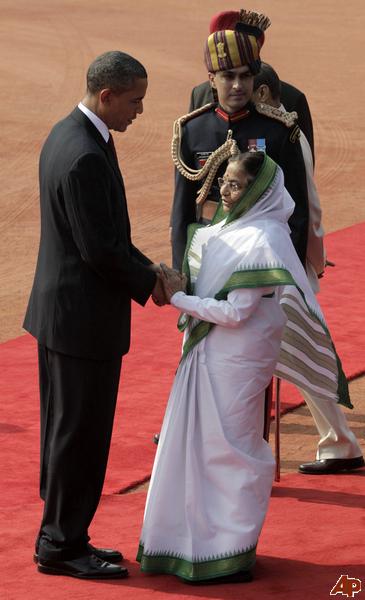
And now we have Ms.Patil:


President Obama's father was from Kenya and next to Pratibha Patil he looks like an especially lofty Masai. How's the weather up there, Barack?
So how do the two top candidates being considered by the Congress measure up? Hamid Ansari hasn't been photographed much with foreign dignitaries, but this picture of him standing next to Omar Abdullah inspires little confidence:


As for Pranab Mukherjee, I think it'll be great for the country if he were made President, mainly because it would remove him from the Finance Ministry, and prevent him from putting in place more ridiculous measures like the retrospective tax he introduced in his last budget. In the stature stakes, though, he is more or less in the Patil league. During his term as External Affairs Minister, it became apparent how vertically challenged he was when he met counterparts like Mr Qureshi from Paksitan:


Ms. Rice from the United States:


And Mr. Milliband from the United Kingdom:


For readers who have not met me, I'd like to clarify that I am short myself, and this post is not inspired by personal prejudice. But since we have a minimum height requirement for the military, why not apply it to the official head of our armed forces as well? There's no evidence that taller people make better soldiers, as the Vietnam war and General Giap make clear. But taller people do make better-looking Presidents, or at least less ridiculous-looking ones.

 Update: Chief Ministers Jayalalitha and Nitish Kumar have put forward the name of P A Sangma as their candidate for President. Mr Sangma is the guy on the extreme left in the photograph below.I'm beginning to scent a conspiracy.


Wednesday, April 25, 2012

The deficit experiment: mid-term results are in

In October 2010, I wrote of divergent approaches to the economic crisis being followed in the United States and in the UK. Well, the mid-term results are in with the UK officially slipping back into recession.
It seems such a simple principle: in a slump raise spending, not taxes. Cut back on spending and raise taxes once the slump is decisively behind you. Yet, both in the UK and Europe, governments have chosen to focus on deficits, dooming prospects for growth, and scrambling deficit reduction targets as a consequence. It's inexplicable behaviour. I'm waiting for an investigation titled Chronicle of a Recession Foretold.

Sunday, April 1, 2012

Annotating Arundhati

Arundhati Roy raises a number of vital issues in her latest polemic Capitalism: A Ghost Story. She's at her strongest when describing the condition of places like Chattisgarh, where corrupt administrations have given over large tracts of land to industrialists through secret agreements; herded sections of the population into concentration camps; and created pro-government militias while branding all protestors Naxalites. Her larger criticism relates to think-tanks, philanthropic foundations and NGOs creating and maintaining a consensus about the way the world's economy ought to be run. I don't believe she's convincingly made the connection between the micro and macro picture. In fact, I find a number of her arguments faulty, error-ridden or plain dishonest. Here's a small sampling of those, with quotes from her essay in italics and my comments below these in normal type.

India’s 100 richest people own assets equivalent to one-fourth of the GDP.

While the figure is shocking, it is also a misleading apples-and-oranges comparison, because 'assets' relate to total wealth, while 'GDP' measures production in a single year.

In India, the 300 million of us who belong to the new, post-IMF “reforms” middle class—the market—live side by side with spirits of the nether world, the poltergeists of dead rivers, dry wells, bald mountains and denuded forests; the ghosts of 2,50,000 debt-ridden farmers who have killed themselves, and of the 800 million who have been impoverished and dispossessed to make way for us.

It is amusing to have Arundhati Roy include herself in the 'middle-class'. She's rich by any standards, a dollar millionaire many times over. There is, of course, a persistent belief among rich Indians that they are only middle-class, and to that extent Roy comes through, for once, as typically Indian.
The passage describes a zero sum game in which 300 million Indians have won at the expense of 800 million losers. There is, however, no evidence that those who are impoverished were better off in the past. India has for millennia been a land where most citizens lived in misery.

The era of the Privatisation of Everything has made the Indian economy one of the fastest growing in the world. However, like any good old-fashioned colony, one of its main exports is its minerals. India’s new mega-corporations—Tatas, Jindals, Essar, Reliance, Sterlite—are those who have managed to muscle their way to the head of the spigot that is spewing money extracted from deep inside the earth. It’s a dream come true for businessmen—to be able to sell what they don’t have to buy.

Roy focuses on mining throughout the piece, and this passage exposes a major fault line in her argument. Groups like the Tatas and Jindals are not among India's biggest exporters of minerals. They want mining leases to assure themselves of supply to their steel plants. There is a constant tussle, reflected in the minister in charge of mining battling the one in charge of steel, between indigenous manufacturers who want exports restricted and exporters such as Sesa Goa who want license to sell anywhere in the world. Roy's erroneous view of Capitalism as an efficient and single-minded monster cannot capture these conflicts.

... by now we know that the connection between GDP growth and jobs is a myth. After 20 years of “growth”, 60 per cent of India’s workforce is self-employed, 90 per cent of India’s labour force works in the unorganised sector.

Non-sequitur. The first sentence speaks about job growth as a whole, and the second shifts to self-employed and unorganised jobs versus organised ones. Has she considered that GDP growth might create opportunities for self-employed and unorganised workers? Sure, it would be good to have more organised sector employment, but that's prevented as much by outdated labour laws and short-sighted unions as by any failure in the market's functioning.

In the summer of 2011, the 2G spectrum scandal broke. We learnt that corporations had siphoned away $40 billion of public money by installing a friendly soul as the Union minister of telecommunication who grossly underpriced the licences for 2G telecom spectrum and illegally parcelled it out to his buddies.

The CAG's voodoo arithmetic has led to a lot of confusion, and Roy happily takes her place among the befuddled. She says corporations "siphoned away" 40 billion dollars of public money. No, they didn't. The money didn't actually exist. It is an estimate of what the government, in the GAG's view, might have earned, had it auctioned 2G licenses and spectrum, instead of following a first-come-first-served policy. The calculation of presumptive loss is itself seriously apples-and-oranges, using 3G prices as a benchmark to estimate 2G income. What laypeople don't seem to realise is that any money accruing to the government eventually comes from our pockets. If the government 'lost' 40 billion dollars, it was money that the telecom firms would have made back by charging us higher prices. Frankly, I'm happy the money stayed in our pockets and tariffs plunged so low that India ended up with the cheapest calling rates in the world.

Of late, the main mining conglomerates have embraced the Arts—film, art installations and the rush of literary festivals that have replaced the ’90s obsession with beauty contests... The Jindal Group brings out a contemporary art magazine and supports some of India’s major artists (who naturally work with stainless steel).

I was for a couple of years the editor of the contemporary art magazine Roy mentions. It was established before the Jindals owned mines. The Sajjan Jindal Group neither was nor is a 'mining conglomerate', but primarily a steel manufacturing business with interests in power generation. It is also wrong to claim the Jindal Group 'supports some of India's major artists (who naturally work with stainless steel)'. The artist most identified with stainless steel, Subodh Gupta, was part of a workshop in Jindal Steel's Vasind campus a decade ago. He has also featured regularly in Art India magazine. But those are very minor entries in his CV. I don't believe the Jindals have patronised any major, or even minor, artist, in the way, say, Harsh Goenka of the RPG Group has done. The Sajjan Jindal Group, by the way, does not manufacture stainless steel. Jindal Stainless is run by a different branch of the family.

But which of us sinners was going to cast the first stone? Not me, who lives off royalties from corporate publishing houses.

Wow, a moment of self-reflection after a decade and a half of pointing fingers. Though she says she won't cast the first stone, Roy chucks a number of missiles in the course of this diatribe. Since she's in an introspective mood, though, she might consider how her international travel would be possible without steel and oil; and how her home could be lit and her PC booted up without power from either burning coal, building dams, or splitting atoms.

What better way for usurers to use a minuscule percentage of their profits to run the world? How else would Bill Gates, who admittedly knows a thing or two about computers, find himself designing education, health and agriculture policies, not just for the US government, but for governments all over the world?

Bill Gates, who has donated far more than a minuscule percentage of his wealth to his Foundation, was among the most powerful men in the world long before he turned to philanthropy. Just because his foundation designs a few policies doesn't mean he runs the world.

Mohammed Yunus and the Grameen Bank brought microcredit to starving peasants with disastrous consequences.

Some of the sheen has come off the microcredit miracle, no doubt, but to suggest Grameen Bank has been a disaster is surely a mistake. Many of those starving peasants stopped starving as a result of access to credit.

The Ford Foundation established a US-style economics course at the Indonesian University. Elite Indonesian students, trained in counter-insurgency by US army officers, played a crucial part in the 1965 CIA-backed coup in Indonesia that brought General Suharto to power. Gen Suharto repaid his mentors by slaughtering hundreds of thousands of Communist rebels.

These kinds of statements most clearly demonstrate Roy's dishonest mode of argument. There are some chaps studying a course in economics designed by the Ford Foundation in Indonesia. A completely different group of 'elite students' supposedly plays a part in a CIA-backed coup. The details of the coup of 1965 have never been sufficiently revealed, but it appears to have been one faction of the army trying to take over the country and failing. I haven't read anything that suggests 'elite students' played a significant role in the operation or in the slaughter that occurred later. But by bringing anti-insurgent students into the picture, Roy creates a sense in our minds that the economics students have something to do with the coup, and, by extension, that the Ford Foundation was somehow involved in the Indonesian massacres of 1965 and 1966. But all the Ford Foundation had done was set up an economics course. It didn't kill any Communists, nor train anybody to kill Communists, nor even, as far as we can tell, train anybody in economics who later killed Communists.

Eight years later, young Chilean students, who came to be known as the Chicago Boys, were taken to the US to be trained in neo-liberal economics by Milton Friedman at the University of Chicago (endowed by J.D. Rockefeller), in preparation for the 1973 CIA-backed coup that killed Salvador Allende, and brought in General Pinochet and a reign of death squads, disappearances and terror that lasted for seventeen years.

More false history. The programme to train Chileans at Chicago originated in the 1950s. Salvador Allende gained power in Chile in 1970. In no sense or form were students from Chile taken to the US 'in preparation' for the 1973 CIA-backed coup. The Ford Foundation had no more to do with the coup in Chile than it did with the coup in Indonesia.

A conservative estimate of the UID budget exceeds the Indian government’s annual public spending on education.

Apples-and-oranges again. Roy appears to be comparing the UID budget for its entire multi-year rollout to an annual budgetary outlay. To provide a more accurate comparison, here are estimates for 2012-13 announced in Pranab Mukherjee's recent budget:
UID: 14232 crore rupees
Education: 48,781 rupees
Education, moreover, is a State subject, which means the total Indian governmental contribution to schooling is far greater than the 48,781 crores allotted by the Centre.

As US universities opened their doors to international students, hundreds of thousands of students, children of the Third World elite, poured in. Those who could not afford the fees were given scholarships.

The whole point of scholarships is to ensure that deserving students don't get left out just because they aren't part of the elite. Roy manages to twist this honourable aim to make scholarships part of a grand Anglo-American conspiracy to brainwash Third Worlders. "Those who could not afford fees were given scholarships" makes the entire grants process seem so easy from the recipients' perspective.

Armed with their billions, these NGOs have waded into the world, turning potential revolutionaries into salaried activists, funding artists, intellectuals and filmmakers, gently luring them away from radical confrontation, ushering them in the direction of multi-culturalism, gender, community development—the discourse couched in the language of identity politics and human rights.

Actually, for decades the billions poured into education programmes and cultural grants by the American government and its proxies failed to turn potential revolutionaries away from the path of radical confrontation. The real problem was that regimes that tried to do away with the market created far more misery and perpetrated far greater atrocities than the system they set out to replace. Eventually, most intelligent people understood that the practical failures of anti-capitalist governments resulted not only from sanctions, embargoes and CIA-sponsored insurgencies, but also from deep-rooted in-built drawbacks. Roy never acknowledges that long and bitter history of failure, except insofar as she purges her writing of anything that could be construed as a positive alternate vision.

Update, April 2: A couple of friends have pointed out that I come across as condoning the corruption of A Raja, and I can see why they see it that way. The 2G scandal is rather complicated, but, briefly, Raja's corruption involved getting firms licenses that would otherwise not have qualified under the established criteria, and blocking a couple of firms who would have qualified. He needs to be punished for this. My objection is to the idea that his acts constituted one of the greatest scams in India's history, a belief fed by the absurd 40 billion dollar figure the CAG dreamt up. Had the licenses been handed out sticking to procedure, the policy would have been preferrable in many ways to the auctions that are now going to be held for anything from spectrum to mining, following a recent Supreme Court verdict. Auctions tend to drive up prices for licenses to irrational levels, and hurt consumers because the costs are inevitably passed on to them.

Friday, March 9, 2012

Murder Incorporated


Syed Modi, who was born poor in a small town in Uttar Pradesh in 1962, broke free of his circumstances by excelling at badminton. He won the national championship at the age of eighteen, beating the great Prakash Padukone who was then at his peak. While junior national champion in 1978, Modi travelled to Beijing for an international tournament. A Bombay girl named Amita Kulkarni was in the women's team, and, as the Supreme Court would later record, "there arose intimacy between the two". Neither the Modis nor the Kulkarnis were thrilled with the idea of the North Indian Muslim boy marrying the upper-class Marathi girl, but the couple resisted family pressure, and wed six years later.
They had a daughter not long afterwards and, while Amita's badminton career was put on hold, Syed continued to rack up titles, winning his eighth consecutive national trophy in 1987. In July 1988, Modi was heading home after a practice session when he was shot dead on a street outside the K D Singh Babu stadium in Lucknow.
The UP police made little headway with the case, and the CBI was called in. They found an eye-witness who had not only seen the shooter but recognised him. They discovered that Amita Modi was having an affair with a state minister named Sanjay Singh, who was descended from the erstwhile royal family of Amethi. Sanjay Singh, in the CBI's view, had instructed a goon-politician named Akhilesh Singh to get Syed Modi killed. Four people were arrested for committing the murder, and Sanjay and Amita spent a small time behind bars. A few months after Modi's death, Sanjay Singh, who had a wife named Garima, married Amita Kulkarni-Modi. He didn't feel the need to hide the relationship, though it was the only imaginable motive behind the murder of a man whose friends described him as a mild guy with no enemies. By 1990, Sanjay Singh had left the Indian National Congress and was a central minister in V P Singh's new government (Sanjay and V P Singh were related). He later moved to the BJP and then back to the Congress. He's currently a Congress MP, but is showing signs of wanting to defect again. His wife, Amita Singh, just lost the election for the state assembly from Amethi, a stronghold of the Gandhi family dating back to the Indira Gandhi days.
It's obvious from this account that Sanjay and Amita were not convicted of plotting to murder Syed Modi. After making bold announcements of having cracked the case, the CBI began chasing its own tail instead of making any further headway. Last year, the former CBI Director Sumit Kumar Dutta published a memoir called Top Cop Recalls. He wrote, about the Syed Modi case: "One day, I received a telephone call from an officer close to the Cabinet Secretary that hearing for framing of the charge in the case was being preponed from the day already fixed for hearing and I should agree to it and not oppose the move. I said that it was not possible as our special counsel was in Mumbai and it was not possible for him to come earlier as there was no time for that.... next thing that came to my notice was that the Director was told to change our special counsel...".
Dutta and the then CBI Director Rajendar Shekhar resolved not to let political interference cloud the case. "He (Shekhar) told me that the Government wanted to know whether the Director would change the counsel. He wanted my views. I told him it was not possible in principle. He agreed with me. He asked me if I was prepared to put in my papers if the counsel was changed. I said ‘yes.’ He felt happy, as he too had decided to do so...Next thing that happened was something unheard of. All of a sudden, in the name of economy, the Government issued an order cancelling the appointments of all special counsels engaged by various departments to deal with their court cases. Therefore, our special counsel’s appointment was automatically terminated. All were surprised, but did not know the real reason."
When the Syed Modi case came to court, all the accused were let off, apart from the shooter identified by the eye-witness. Two acquitted underlings were soon found shot to death themselves. Needless to say, those murders have never been solved.
Sanjay Singh was in the news a few months ago, opposing his own party's decision to allow foreign investment in retail. Singh said the measure would hurt the poor, who are always foremost in his mind. Amita just gave an interview to NDTV speaking of how times have changed and dynasties like the Gandhis don't matter any more. The two will doubtless be welcomed into whichever party they decide to join next.
I've met taxi drivers from the Amethi region who speak of Sanjay Singh's power. Locals, they say, might be beaten for even looking him in the eye, men have to keep their head bowed in his presence. Syed Modi obviously got uppity, and paid the price.

Saturday, December 10, 2011

The army's special powers and Lord Curzon

Yesterday, on the eve of Human Rights Day, Clark House (an arts initiative run by Zasha Colah and Thakur Sumesh Sharma), Tushar Joag and Sharmila Samant put together a programme of screenings and discussions titled Against AFSPA at the National Gallery of Modern Art. Apart from a demand for the repeal of the Armed Forces (Special Powers) Act, it was an act of solidarity with Irom Sharmila, who has been on a fast for over a decade in protest again the repression of Manipuri citizens by the Indian army and paramilitaries. She has been held captive for attempted suicide and force-fed for all these years.
I was pleasantly surprised that an event so harshly critical of Indian state policy was taking place inside a government-run institution. Maybe the NGMA Director Rajeev Lochan's bureaucratic exterior conceals a radical, subversive agenda.
The proceedings were chaotic, bearing only a passing resemblance to the schedule provided on the invite. But they did a good job of demonstrating how insanely cruel the Indian government has been and continues to be to the people of Manipur. For over fifty years, an emergency law has been in place permitting soldiers to arrest, rape and kill with impunity. Mihir Desai, a participant in a panel discussion about AFSPA, and the only person on stage who spoke cogently, pointed out that any prosecution of soldiers needed central government sanction; and that, from over 500 cases forwarded to Delhi for consideration (I forget the exact number Desai mentioned, I think it was 581), not a single trial has been green-lighted.

I thought of Lord Curzon who, at the end of the nineteenth century, had a series of run-ins with the British army. Soon after he arrived in India as Viceroy, he heard that soldiers from the West Kent Regiment had gang-raped a Burmese woman. The perpetrators had gone unpunished after witnesses were threatened, and the matter covered up. Curzon had the culprits dismissed from the army and the entire regiment transferred to Aden (a punishment posting in those days) and denied leave or benefits for two whole years.
In 1900, after a private in the Royal Scots Fusiliers battered to death a 'punkah-coolie' (a man who operated cloth fans), Curzon wrote: "That such outrages should occur in the first place in a country under British rule; and then that everybody, commanding officers, officials, juries, departments should conspire to screen the guilty is, in my judgment, a black and permanent blot on the British name. I mean, so far as one man can do it, to efface the stain while I am here.”
In 1902, three troopers of the 9th Lancers Regiment (a cavalry outfit packed with members of the British upper class), just arrived in Sialkot, beat a cook named Atu so badly that he died after nine days of agony. Curzon lashed out at the biased investigation which, he wrote, "Consists of two Captains and a subaltern, not one of whom so far as I can make out, understands a word of Hindustani. Their idea of taking evidence and holding an inquiry consists in examining four witnesses, all natives. They never think of sending for the doctor or for a non-commissioned soldier or for the inspector of police. In fact they make not the slightest effort to arrive at the truth... I will not be a party to any of the scandalous hushing up of bad cases of which there is too much in this country, or to the theory that a white man may kick or batter a black man to death with impunity because he is only a 'd- d nigger'.”

Some day we might get a leader in Delhi who has the courage and moral conviction to hold soldiers responsible for a few of the innumerable atrocities perpetrated in Kashmir and the North-East over the past decades. Right now, we can't even provide the millions of citizens living under AFSPA as much protection from the army's cruel excesses as the British colonial system did.

Saturday, December 3, 2011

The myth of creating consensus

Every time a row erupts in Parliament, there are MPs and medipersons who accuse the government of 'failing to evolve a consensus on the issue'. Chetan Bhagat's take in today's Times of India on foreign investment in retail is typical. Titled Shopping for Consensus, the argument advanced in the article has three facets. First, that FDI in retail is a smokescreen to occlude more important issues like the Lokpal bill. Second, allowing Tesco and Walmart to open supermarkets in India is a good thing in itself. Third, that "the government, with humility, should involve everyone in Parliament to get a general policy consensus on FDI, not just for retail, but all sectors, across all industries."

In other words, talk sweetly to Prakash Karat and he will hit the Like button of WalMart's Facebook page. Bhagat ignores the simple truth that there exist in every parliament ideological divisions which cannot be bridged. Electoral democracy would be pretty useless if that wasn't the case, since we'd have a choice between Tweedledum and Tweedledee.
Moreover, even when two parties have economic policies that are as similar as Tweedledum and Tweedledee, which has been the case with the Congress and BJP over the last two decades, the party in opposition will fight policies tooth and nail that it would support as head of a ruling coalition. And it will not budge despite all the discussion and consensus building in the world. This happened with the civil nuclear deal and is happening again in the present dispute. What has changed is that Parliament is growing dysfunctional, with increasingly frequent disruptions and forced adjournments.

David Ben Gurion said that for every two Jews there are three opinions. This is equally true of Indians. Doesn't it describe all communities? To a degree, yes, but I suspect that in the case of our largest neighbour, "Two Chinese, one opinion" is likelier. Evolving consensus in India is an impossible task. Nehru fought for years to get the Hindu Code Bill passed; and he couldn't manage anything close to unanimity even within his own party in that time. In recent months, the BJP has been uncooperative in introducing non-controversial, non-ideological changes, such as a nation-wide Goods and Services Tax. What's the likelihood, then, that the main opposition party will accept government policy in a matter where there are votes to gain by the bushelful?

Wednesday, August 31, 2011

Anna the Fanatic

Anna Hazare rules the village of Ralegan Siddhi with unquestioned authority. He forces meat eaters to turn vegetarian; has men who drink liquor tied to a tree and beaten; prohibits cable TV; disallows political campaigning and elections.
There's a word for this sort of person: it is 'fanatic'. Everything about Hazare's behaviour, his posture in negotiating, his threats and fasts, points to a fanatical and authoritarian personality, a modern Savonarola. But the word fanatic has never cropped up in the media in relation to Hazare. Maybe it is because the man doesn't give fiery speeches.

Tuesday, August 30, 2011

Anna Hazare and individual mobilisation

The first time I attended a demonstration, I was struck by an odd fact. Most of the audience was poor, composed of party members trucked in from different parts of Bombay and, perhaps, out of town. The speakers were all middle class graduates. Those attending didn't seem deeply involved in the cause being discussed, they were just there to make up the numbers.
The same pattern played out repeatedly in succeeding years. I did attend a few demonstrations composed of motivated individuals, but these were inevitably small. For example, I was part of a group that would march on August 6 demanding an end to all nuclear weapons. I don't think we ever had more than a hundred people at any public meeting.
It was different in England, where I noticed a greater homogeneity between protestors and those who addressed them. Though the demonstrations I attended in England were fairly small, far larger ones, such as marches against the Iraq war, drew thousands, sometimes hundreds of thousands of individuals in Europe and the US based on shared beliefs rather than party membership. Labour unions and political parties were often part of such marches, but a substantial portion of the demonstrators seemed to be independents who had just turned up because they believed in the cause.
The anti-corruption crusade is perhaps the first large-scale demonstration in India that has not involved political parties drumming up support and trucking in the public. The middle-classness of the movement has come in for criticism, but I can't imagine poor people spending valuable hours to protest in favour of something as abstract as the Jan Lokpal bill.
In the latter stages of Anna Hazare's fast, various unions showed support by striking work, and they probably had a party-political background; but the crowds at Ramlila Maidan appeared to be composed of individuals and small groups of friends and family members without strong party affiliations. In that sense, the Lokpal movement has something in common with the Arab Spring. It's probably the first time a nation like Egypt saw such individualised demonstrations. As in Egypt, all established parties in India seem to have been taken unawares by the intensity and persistence of the demos; politicians are used to being able to label crowds, and they were left playing catch-up in this instance.

This might also tell us something about the changing nature of Delhi. I've argued the city is taking on the aura of an imperial capital, but, contrarily, it is also becoming less dominated by politics. In past decades, a substantial portion of the middle class population of the capital was directly connected to the government. I haven't seen statistics, but I'm certain the percentage has fallen dramatically.

Monday, August 29, 2011

Amitav Ghosh on Anna Hazare and the deep State

Some of India's best thinkers have written about the Anna Hazare movement, and now Amitav Ghosh joins the group with this article in the Hindustan Times. While agreeing with Ghosh's analysis of the malaise within the Congress Party, where position has been divorced from true power, I find myself wishing he'd gone further and spoken of the same thing happening among opposition parties.
During the Shiv Sena-BJP government of the 1990s in Maharashtra, real power vested in Bal Thackeray who, unlike Sonia Gandhi, didn't even fight elections. To this day, no Thackeray has ever bothered to fight state or national elections. It was to Bal Thackeray's home and not the Chief Minister's office that Rebecca Mark of Enron went, straight from the airport, when attempting to get the Dabhol project restarted. The result was a U-turn by the ruling coalition and a financial disaster for the state.
The BJP boasts, with a lot of justice, of not harbouring dynasties, and of changing party heads democratically. However, it faces its own 'deep State' crisis in its relationship with the RSS, whose unelected leaders have have veto power over decisions taken by BJP ministers.
Another feature of 'deep State' politics, as Ghosh points out, is the refusal to reveal details of illnesses suffered by top leaders. The secrecy surrounding Sonia Gandhi's surgery is very similar to that surrounding Hugo Chavez's treatment in Cuba; and of Fidel Castro's illness. Here, again, the BJP was no different, having drawn a veil over Atal Behari Vajpayee's health problems while he was Prime Minister.

Thursday, August 25, 2011

Delhi in the Time of Anna

On the flight I chat with a woman who works with ONGC, in finance. She's deeply sympathetic to the Lokpal campaign. She cites problems ONGC faces because it's a government organisation. Like, it has been headless for months, despite being one of the nation's most valuable companies.
"The stay on appointing a Chairman is coming straight from the PMO, so don't tell me Manmohan Singh is not corrupt. People say he could not control Raja because of coalition politics; but why can't he control this kind of thing in his own office?"
She tells me ONGC hired expensive rigs from Reliance, because Reliance had hired them and had no use for them. ONGC has no use for them either, but is now picking up the tab instead of Reliance.
This is all, of course, hearsay.
In the Delhi metro, on the streets, in cars, I see people carrying the tricolour and wearing Gandhi topis inscribed with Anna Hazare's name. Drivers can talk of little else, since they've faced Anna-related traffic jams for days.
Yesterday, I took the Metro to Chandni Chowk, and then back to Gurgaon. I was in a hurry and very tired when I got off at HUDA City Centre, and in no mood to haggle with rickshaws, so I agreed to pay the driver a ridiculous sum for the short drive to my destination. He said, "Our union forced us to strike today in support of Anna. I've only plied this auto from 6pm, so I have to overcharge today."

Tuesday, August 16, 2011

Aarakshan, Anna Hazare and Narendra Modi


Aarakshan (spoiler warning) is two films in one. The first half is about quotas in education, caste rivalry, and the debate about what constitutes merit. The title suggests the entire film is about these things, but the title is misleading. By the interval, Saif Ali Khan is estranged from his girlfriend Deepika Padukone, their buddy Prateik Babbar has fought with both of them; Amitabh Bachchan has quarreled with his closest colleague, been removed from his job, and debated his wife to a stalemate; all because of the issue of caste-based reservations. There's even an attempt, a spectacularly unsuccessful one, to use affirmative action metaphors in a romantic song (Prasoon Joshi's words in Mauka outdo the most atrocious of Javed Akhtar's youth-brigade lyrics, the sort Akhtar wrote for the girl-band Viva). One wonders where Aarakshan could possibly go from here.
Prakash Jha's answer is to leave the reservation issue behind, and move on to the problem of mercenary tuition classes, capitation fees, and the collusion between educators and politicians. This shift rearranges loyalties, leaving all the good guys on one side of the divide and all the bad guys conspiring against them. The Amitabh character's response to the rise of high-fee coaching classes is to set up free special classes in a cattle-shed. His solution to the education sector's ills is obviously unworkable, resting as it does on the generosity of individual teachers and the munificence of charitable institutions. I suspect that paying teachers decent wages is more likely to promote quality education than asking them to teach for free. Despite the naive idealism of this answer, Aarakshan succeeds in tapping into the common feeling that something is rotten in the state of India's higher education, and the film can therefore present itself as offering an alternative to the evil status quo.
Anna Hazare's movement, it seems to me, works on the same basis. It eschews those things which fundamentally divide civil society, and instead taps into popular outrage against corruption in politics and daily life. Everybody is against corruption, just as everybody is for peace and harmony. The solution Hazare's movement offers in the form of the Jan Lokpal bill is as naive as Amitabh Bachchan's classroom-in-a-tabela. There have been a number of critiques of the proposed bill, but I'll link to just one, an article by Pratap Bhanu Mehta which contests both the methods and substance of the Lokpal agitation. The establishment of the Lokpal as envisaged by Hazare, Bedi, Kejriwal and the Bhushans, will do almost nothing to curb corruption; if set up in the form the activists want, it will only add a layer to India's bureaucracy, a layer which will soon turn as corrupt as all the other layers.

I recall another naive solution which united civil society a while ago. Shocked at images of hundreds of tonnes of foodgrains rotting while food prices soared, the Supreme Court asked the government to provide the grain free to the poor, not appreciating that the government could only do so through the public distribution system, and that it was precisely because of the shortcomings of the public procurement, storage and distribution system that so much food was rotting in the first place.

Aarakshan arrives at a happy ending through a deus ex machina (or a diva ex machina). Just when Amitabh's school-in-a-tabela faces being bulldozed, Hema Malini, chairperson of the trust that employed Bachchan as College Principal, returns from her decades' long spiritual retreat, and makes a call to the state's Chief Minister, who promptly orders the police and municipal employees to cease and desist. In other words, the good guys win because they can make a phone call to a higher authority than the bad guys; their most powerful person has more pull than the most powerful person among the villains. A quintessentially Indian conclusion.
Nobody in the audience blinks at the idea of police officers doing Ministers' bidding. That's just the way our system works. If the Home Minister says 'arrest', they will arrest, if the Chief Minister then says 'release', they will release.

Which is why officers who have provided investigating commissions with data that implicates Gujarat Chief Minister Narendra Modi and his colleagues in the horrific massacres of 2002 are being suspended and chargesheeted, while those who helped in the cover up have been consistently promoted. The subversion of the system is happening before our eyes. Yet, there is little outrage about it, certainly nothing to match the fervour generated by Anna Hazare's agitation. That's partly because so much time has elapsed since the Gujarat riots, and so much has been written about them, that people are sick and tired of the issue. But it's also because the 2002 riots, like the Mandal Commission report and the issue of reservation in general, divide society. Narendra Modi has been elected and re-elected despite his apparent complicity in mass murder. His supporters, in a Pavlovian response to criticism of their hero, parrot the 'What about the 1984 anti-Sikh riots' line whenever the 2002 massacres are brought up. In 1984, our systems were so crude and compromised that no proof could be found that X or Y led rioting mobs. The fact that the justice system failed then is hardly an excuse to allow it to fail again, as if each side is entitled to one pogrom free of charge. This time round, we possess call records, minutes of Cabinet meetings, videographed witness testimonies, and a wealth of other evidence aided by the introduction of new technology between 1984 and 2002. We have high ranking IPS officers willing to testify under oath that there was a government backed effort to generate anti-Muslim hysteria in Gujarat; government-sponsored demonstrations that were meant to turn violent; and government-mandated inaction on the part of the Gujarat police.

There are tough questions facing us: Can we bring a Bal Thackeray to justice? Can we bring a Narendra Modi to justice? What does it say about our commitment to the rule of law if we cannot? Though the questions are tough, they can be resolved through relatively simple procedures in place already. However, there is little pressure from the public to get those procedures right. I see few Facebook petitions relating to police officers victimised for telling the truth about horrific crimes. Like the issue of reservations in Aarakshan, the murders of 2002 seem best forgotten after an interval.

Thursday, July 14, 2011

The Girl with the Dragon Tattoo and the bomb blasts


I watched a bit of the Swedish adaptation of Girl with the Dragon Tattoo last night. It was better than watching ranting anchors and ranting politicians and ranting analysts, but even so I couldn't watch more than 15 minutes. Adaptations usually employ actors who look better than their literary counterparts. It's a sensible policy, because it's easier to read about ugly people than to watch ugly people on screen for extended periods. For some reason, the Swedes decided that they would make all the Dragon Tattoo characters plainer than they are in the book. There's Larsson's hero Mikael Blomkvist, for example, a middle-aged journalist who has a mysterious power over women. For those who have not read Stieg Larsson's trilogy, it's worth knowing that the male characters are, almost all of them, rapists and murderers; Blomkvist is the very opposite. He's good with women, and quite indiscriminate in his tastes. He sleeps with every woman he meets and, unlike James Bond, doesn't even have to seduce them. Without exception, they make the first move. Reading the books, you wonder why so many women would fall for him; and watching the actor playing him makes suspension of disbelief even tougher. Maybe the actor is famous in Sweden, in which case his fame might have compensated for his lack of charm. But the director has decided to film everybody in the most unflattering light possible, so they all look corpse-grey and unsexy in the extreme.
For the English adaptation, they've apparently got James Bond playing Mikael Blomkvist. Daniel Craig will probably be pleased to ditch the seduction routines.
I guess I should say something about the explosions. One was about a kilometer from my home as the crow flies, and another about a kilometer from where I was last evening. I was leaving a Kemp's Corner bookshop when I got a message about the first blast; within a minute all phone lines were jammed. I decided to eat a sandwich in the bookshop's cafe, giving any other bombs that might have been planted time to explode. Afterward I got a cab home. The streets were calm and not very crowded.
Bombs are something we have to live with now. Obviously, like other nasty things we have to live with, such as murder and robbery, it's important to minimise the number of incidents. We haven't had any attacks for two years and a half, which I think is good going. I'll happily take one attack every two years that kills about twenty of us, and accept the risk of being one of those twenty next time round.
For those who don't know Bombay well, more than ten people die on the city's rail tracks every day. Over twenty thousand have died in the past five years hit by trains while trying to cross the tracks. Many of those could've been saved if we had a good rescue service organised. But we don't. We depend on guys living by the tracks who haul bloodied and broken bodies to hospitals, and then wait for tips from relatives of the wounded or dead.
Deaths on rail tracks are very different from deaths from terrorism, of course. The individuals took a risk by crossing the tracks, and broke the law as well. I don't want to suggest an equivalence between the two modes of dying. I'm just pointing to how atrocious our systems and infrastructure are. Considering that, and considering it isn't all that difficult to make a bomb, I'm surprised we have not had more attacks since November 2008. Also that other cities have not had more attacks. We need only look at Pakistan's current condition to understand how bad things could get.

Wednesday, June 15, 2011

Swami Nigamanand's death and CNN-IBN's lies

Swami Nigamanand's death has made news because it contrasts so clearly with Baba Ramdev's recently concluded fast. Nigamanand fasted for weeks, outside the media spotlight, against illegal mining along the Ganga. Ramdev, protesting corruption in general and dominating prime time while doing so, wasn't able to keep his fast going for long.
Now CNN IBN is claiming Nigamanand was poisoned. "Swami Nigamanand's pathology report says that he he (sic) died of insecticide which was administered to him during the duration of his stay at the government hospital", the news item on CNN IBN's website says. IBN is running it as one of their top stories on both their Hindi and English news channels.
Now, what would a responsible news organisation do, having got hold of a pathology report? I suggest it would contact a doctor to interpret it. No chance of CNN IBN doing that. They're speaking to a District Magistrate and Nigamanand's colleagues, but haven't aired any expert opinions about the report. And it's easy to see why. Here are two grabs of the document from the TV screen. The frame, typically, is never still. Instead we get a series of quick pans and zooms so we can't really read much aside from what the channel chooses to highlight.


From what I can tell, the report suggests the toxicity in Nigamanand's blood sample could arise from any one of four causes:
Organophosphate poisoning
Liver disease such as Hepatitis or cirrhosis
Liver cancer
Malnutrition

Given that the man had gone without food for months, what would you conclude from this? That the swami died from malnutrition (option 4); or that somebody administered him instecticide in the hospital (option 1)? CNN IBN has chosen Option 1, and is carrying it as its top new story. Great way to make a living, Rajdeep Sardesai and company.

The controversy about the pathology report has overshadowed what, to me, seems a more justifiable line of inquiry, namely, why did the Swami die at all? Even comatose patients are kept alive in hospitals for years, so there really doesn't seem any good reason why the man should have died. The post-morten states he suffered from septicaemia. Again, why would he get septicaemia in a hospital? It seems to indicate laxity in his treatment, but I'm not qualified to make a solid judgement. My doctor friend DS is away in Switzerland, but I hope some other physician will weigh in on the issue.

Monday, June 6, 2011

It's the army, stupid.

My latest Yahoo! column explores why India remained democratic when so many developing countries were taken over by dictators. Read it here.

I've been off the blog for a while, but promise to post more often in weeks to come.

Wednesday, May 4, 2011

Digvijay Singh and bad old Congress habits

Digvijay Singh, who, a few months back, lied about phone conversations with Hemant Karkare, is a throwback to the worst sort of Congress 'secularism'. It's a secularism which panders to religious conservatives among Hindus as well as Muslims. It began under Indira Gandhi and peaked in Rajiv Gandhi's time, symbolised by the twin acts of overturning the Supreme Court verdict in the Shah Bano case, and opening the gates of the Babri Masjid to allow a shilanyas to take place. These actions, instead of pleasing members of both communities, led instead to sectarian polarisation, and to Muslim as well as Hindu partisans being able to speak with some justice of the Congress favouring the other side.
Under Manmohan Singh, the party has generally avoided dabbling in religious issues, which is great. But Digvijay Singh, as I said, is a throwback. As Chief Minister of Madhya Pradesh, he tried to counter the BJP by launching his own campaign for a nationwide ban on cow slaughter; extolling the virtues of cow urine; and accusing his opponent Uma Bharti of offering non-vegetarian cake to Hanuman.
Recently, he's switched to feeding off Muslim resentment. Yesterday, for example, he criticised the United States for not giving Osama bin Laden a sufficiently Muslim burial. Well, if he has a problem with Osama's final rites, he should be even more critical of the way the 26/11 terrorists were treated. The bodies of the nine dead men were embalmed, in direct contravention of Islamic norms, and kept on ice at the J J Hospital morgue for fifteen whole months, though orthodox Islam demands a burial within 24 hours. We have no idea if any religious rites were conducted before their bodies were finally placed in the earth.
Digvijay Singh's own party rules Maharashtra state; why didn't he lobby for a proper religious burial for the nine Bombay terrorists, since he has so much concern for mass murderers?

Monday, April 25, 2011

Fast food and smoking guns

My Yahoo! India column this time is about media time versus real time. Read it here.

Monday, February 7, 2011

Mangled Anthems

Christina Aguilera's been singing the Star Spangled Banner at public functions since she was a kid, but evidently hasn't learned the words yet. She flubbed the fourth line of the national anthem sung at the start of the Super Bowl. Should a singer do something like that to the Indian national anthem, she would have a dozen criminal cases filed against her in far flung courts ruled by attention-seeking magistrates.
We take our national symbols seriously. Three years ago, Sania Mirza was accused of insulting the national flag because she put her bare feet up while resting after a Hopman Cup match, and a photographer clicked a low angle shot that suggested the feet were in close proximity to an Indian flag placed on an adjoining table. This was enough for a criminal charge.


There's a folded khadi flag in a cupboard in our home, which used to be flown during Independence Day and Republic Day in the idealistic days of the 1950s. Somewhere down the line, the government forbade citizens from hoisting flags because of the potential insult to the nation, should they be flown upside down. It took a petition filed by Naveen Jindal and a Supreme Court verdict to reverse the idiotic policy, but those who inadvertently put the green above the saffron can expect to be hauled off to jail.
All of which makes a Borat-like performance impossible in India. I mean, a guy could pretend to sing the Kazakh national anthem to the tune of Jana Gana Mana at a public function, but once the film was released (abroad that is, it would be banned in India) PILs, extradition demands, and death threats would inevitably follow. Luckily there are places where expression is freer, and so we have Sacha Baron Cohen's fabulous mangling of the Star Spangled Banner to laugh at. The horse rearing and falling at the end of the sequence, which can be seen here, is an unexpected bonus. Like the bird flying to the centre of the frame and diving straight down into the water at the end of Barton Fink.

Wednesday, January 5, 2011

Digvijay Singh's lie about Hemant Karkare


Here's what Digvijay Singh said in an interview with the Indian Express published on December 11, 2010: “On November 26, 2008, at 7 pm, just about two hours before the attacks in Mumbai started, Hemant Karkare, the slain ATS chief rang me on my mobile and told me how his family and his life were blighted by constant threats from people annoyed by his investigations into the Malegaon blasts."
The remark became controversial, and Maharashtra's Home Minister R R Patil issued a statement saying there was no record of Karkare and Singh having spoken at the time mentioned. Now, Singh has produced telephone records which he claims vindicate his position. Except they do not. What the records show is that Singh called Karkare, not the other way round. It's a crucial difference. I don't like the idea of police officers contacting politicians to whine: I'd think less of Hemant Karkare if he'd done what Digvijay Singh said he did. However, if a politician calls a police officer he is acquainted with, it's perfectly acceptable for the policeman to mention in passing that he is being threatened. Moreover, we only have Digvijay Singh's word for what was actually said. If Singh could lie about who called whom, he could well twist the contents of the conversation.
I've been very critical about the police in a number of posts on this blog. There are, however, a few perfectly honest, dedicated officers who stand apart within the force. Hemant Karkare was one of them. Digvijay Singh lied when he said Karkare called him the day he was killed. I hope newspapers and TV channels covering the issue highlight the difference between making a call and answering it.

Tuesday, November 9, 2010

An accountability law

The MMRDA has revoked the Adarsh society's occupation certificate, and the society has replied that it was built after obtaining all required permissions, and will go to court against the revocation. The episode follows a common pattern: permits are provided by corrupt officials in contravention of norms; at some point, the issue becomes public knowledge thanks to activists and investigative reporters; then, the administration reverses the permission with a stroke of the pen, harming a number of people who were not part of any underhand deals.
I recall a few years ago, most taxis in the city had switched to horrid smoke-spewing three cylinder engines; after a PIL, the administration decided all these retrofitted engines were illegal and would have to be junked. Many taxi drivers who had followed a trend presuming it was legal were saddled with unbearable costs. The permits they had received were suddenly useless. The people who issued those permits suffered no adverse consequences.
Should there not be an accountability mechanism in place for such incidents? Perhaps we need a law stating that permits once given cannot be cancelled UNLESS action is taken against officials responsible for handing out those permissions in the first place. And the action against bureaucrats can't be mere suspension, for many of the culprits retire to lives of luxury before their misdeeds come to light.
If there are any lawyers reading this, I'd like to know if it's theoretically possible to develop a provision of this sort. Could we have a requirement, for example, that an FIR be filed simultaneously with any such revocation of permit?