Showing posts with label Cinema. Show all posts

Tuesday, December 25, 2012

Pulp Fiction, Morality Play

Not long after Quentin Tarantino's Pulp Fiction was released, I wrote a piece for a small magazine arguing the film had a moral centre that was being missed. I elaborated on that idea years later in a lecture to a film club. In anticipation of the release of Django Unchained (which will, I hope, soon come to India as Django Uncensored), I'm putting a version of that talk on my blog. Christmas Day feels appropriate for it. I've cut the essay drastically, but it's still pretty long. However, since the film is now an established classic and nobody else appears to have written about it from this perspective, I believe it's worthwhile having it online in some form.

Synopsis
I argue in this essay that Quentin Tarantino’s Pulp Fiction is a profound as well as subtle ethical exploration. The three main male characters represent three central tendencies in European moral thinking: the Christian, the Aristotelian and the Hedonistic. The film bridges the divide, highlighted by Nietzsche, between Greek and Christian ideas of virtue. While such a bridge is not unsual in itself, the film deviates from tradition in affirming the virtues of pride and sacrifice in individual characters, while denying those virtues any general or universal validity. Whereas the Hollywood tradition of virtuous heroes performing virtuous deeds is simplistic and politically fraught, Tarantino separates subjective from objective, allowing for the approval of noble impulses without a consequent approval of the actions which result from these impulses.
Since the making of Pulp Fiction, Tarantino’s moralism has become progressively more overt. Perhaps this is a result of the failure of critics to appreciate the moral basis of his most important film. His recent, obvious manifestations of moralism lack the power of his 1994 classic, which communicated itself to audiences even though they may not have be aware of its ethical roots.


The Critics
Quentin Tarantino’s first two films, Reservoir Dogs, made in 1992, and Pulp Fiction, released in 1994, quickly established him as the most influential director of the decade. As screenwriter or executive producer, he piloted a number of other films, such as True Romance and Killing Zoe, which, together with a host of similarly themed movies like The Usual Suspects created a popular new genre. Typically, these films were violent and funny, stylish and hip, and focused on criminals, often groups of them rather than individuals. It was called, by one biographer of Tarantino, ‘the cinema of cool’.
Tarantino’s films and their clones were appreciated by audiences and critics alike, but also came under attack for their perceived lack of substance, and their use of violence. Charles Taylor, film critic of the left-leaning web magazine Salon.com wrote, “For me, the effect of Pulp Fiction isn't much different than the effect of any big, impersonal action picture. The audience knows from the start that everything has been set up for effect and that there's nothing to believe in or care about.” At the other side of the political spectrum, John Gautereaux, of the conservative Christian organisation Neopolitique, excoriated Tarantino’s perceived nihilism in an essay titled This Dog Has No Reservoir. Gautereaux began by acknowledging the stylistic accomplishments of Pulp Fiction, but complained that “Today's movie audiences, although quite knowledgeable, seem intent on being entertained, not challenged.” He compared Tarantino’s characters unfavourably with those of Frank Capra, director of loveable screwball comedies from the 1930s: “While Capra's films are tagged as 'say-something' movies, Tarantino's have nothing redemptive to say, even to themselves.” About Tarantino’s characters, he wrote: “no matter how many humorous catch-phrases they utter, his characters say nothing transcendent. Tarantino's characters are primarily interested in surviving the here and now.”
Mary Kenney of the left-wing British tabloid The Daily Mirror. Kenney wrote that Tarantino’s films were “disgusting, violent, repellent, dangerous to young and unformed minds, childish, irrational, horrible, agonising, and distressingly like something out of a Nazi nightmare where human beings are subjected to every degradation just for the hell of it."
A few critics had recognised that the tale of trust and betrayal in Tarantino’s first film, Reservoir Dogs, had a moral basis. The Christian overtones in the relationship between a robber (Harvey Keitel) and a cop pretending to be a robber (Tim Roth) were too obvious to be ignored completely. Moreover, these themes were already familiar in the work of two other Catholic, Italian-American directors who, like Tarantino, were preoccupied with tales of underworld violence: Francis Ford Coppola and Martin Scorcese. Scorcese had always been open about the Catholic underpinning of his stories. They aren’t propaganda for the Catholic cause, in the manner of Mel Gibson’s film The Passion of the Christ, but revolve around and question certain persistent issues in Christian myth and ethics. Since trust and betrayal are central themes in the story of Christ it was easy to incorporate Reservoir Dogs into the Italian-American gangster movie tradition of Scorcese and Coppola.
In which case, why not see Pulp Fiction in a Christian moral context as well? How could John Gautereaux claim that “Tarantino's characters are primarily interested in surviving the here and now”? Doesn’t one of the characters, played by Samuel Jackson, mouth lines from the Book of Ezekiel? (Mixed, Tarantino style, with a quote from a karate flick starring Sonny Chiba) Doesn’t he undergo a religious conversion which makes him rethink his entire way of living? And doesn’t he undertake the most elaborate exegetical exercise in the history of Hollywood, when, near the end of the film, he considers different interpretations of that paragraph from Ezekiel?
Somehow, the form of Pulp Fiction, its humour and many conscious absurdities, prevented critics from allowing Jackson’s character any significant moral purpose. The film’s title itself seemed to announce its lack of depth, referring as it did to a cheap paperback genre of the 1950s. Maximilian LeCain, an Irish film-maker and writer, one of the few to actually consider the Christian connotations of Pulp Fiction, quickly dismissed the whole thing as a sham: “The lazy, dishonestly moralistic about-turn that Tarantino makes with Samuel Jackson's 'redemption' in Pulp Fiction is ultimately of little consequence amid the self-satisfied posturing of that film because the full extent of its 'moral vision' is no more than immanent glibness.”


Butch
In my view, the character played by Bruce Willis in Pulp Fiction represents the Greek virtue of pride, while Samuel Jackson represents the Christian virtue of sacrifice. Through these two characters, we feel a commonality between the opposed virtues of the two ethical systems underpinning European thought. I say opposed because, while Aristotle considered pride the greatest virtue, Christianity deemed it a deadly sin. For the Greeks, pride was an essential aspect of greatness, though it could cause a hero’s downfall if it became hubris. The qualities the Greeks valued, not just pride but courage, justice and honour, could be termed masculine virtues. In fact, the word virtue is derived from the Indo-European root ‘vir’ meaning, simply ‘man’. Virtue has the same root as words such as virile, and also werewolf. ‘Vir’ became ‘wer’ in Old English, so werewolf meant ‘man-wolf’. The Sanskrit word ‘vira’ meaning man as well as hero, is also derived from the same root.
 Consider the first time we see Bruce Willis, or Butch Coolidge as his character is named. He is being offered a packet to throw a fight. Marcellus Wallace, a gangleader who is fixing the fight, speaks a lot about pride (Starting 2.10 in this clip). He attempts to convince Bruce Willis that “pride never helps, it only hurts”, that Butch will have to forget his pride for material gain. In the event, Butch refuses to throw the fight, thuse re-asserting the power of pride. Later in the narrative, when he and Marcellus run into each other, he throws Marcellus's words back at him along with a few well-aimed punches, "You feel that sting? That's pride fucking with you" (1.40 in this clip).
It could be argued that pride has nothing to do with Willis’s actions. He makes a lot of money betting on himself at a minimum risk to his life. However, the narrative develops in ways that highlight pride over mercenary plotting. Though he knows Marcellus will be looking for him after being double-crossed, Butch returns to his home to retrieve the heirloom that is the source of his pride: a gold watch worn by his warrior father and his warrior grandfather before him, and originally purchased by his great-grandfather Erine Coolidge just before he set sail for Paris to fight in the First World War.
The way Tarantino deals with the story of the heirloom is crucial to my understanding of his moral innovation. The history of the artefact is related by an army officer who survived the Vietnamese POW camp that claimed the life of Butch’s father. The story begins conventionally, one may even feel emotionally involved in it at the start. But it rapidly becomes funny, ridiculous and finally scatological, with an account of Butch’s father hiding the watch in his rectum and then dying of diarrhoea. By this time, it has lost all pretensions to gravitas. The only person in the world who takes the heirloom seriously is Butch himself. This split between the audience’s view of the watch and Butch’s own is enhanced in a scene where Butch discovers his girlfriend has failed to pack the watch in preparing their getaway. He keeps repeating that the watch was, “beside the table drawer on the little kangaroo”. Though Butch himself is distraught, the audience is diverted by the absurd kangaroo. We feel Butch is doing a brave thing by going back, but feel no connection with the object of his quest, the watch next to the kangaroo. Tarantino divorces our attitude to Butch’s motivation from our attitude to his goal.


Jules
Exactly the same split takes place on the Christian side of the story. Jules (Samuel Jackson) undergoes a conversion after six bullets, which should have killed him and his friend Vincent (John Travolta), end up hitting the wall instead. Vincent sees it as happy chance, perhaps helped along by the extra heavy gun the shooter carried. He takes with a pinch of salt Jules' conclusion that God diverted the bullets from their fatal path. Later on, when they’re sitting in a diner, and Jules mentions he is thinking of the miracle they witnessed, Vincent responds; “The miracle you witnessed. I witnessed a freak accident.” Jules says, “You’re judging this the wrong way. You don’t judge stuff like this based on merit. Whether or not what we experienced was an according-to-Hoyle miracle is insignificant. What is significant is I felt God’s touch.” In this exchange, quite explicitly, a distinction is made between subjective experience and objective reality. The moral worth of a subjective experience cannot, in Jules’ framework, be judged by objective standards. Just as the subjective value attached by Butch to his watch cannot be judged in objective terms. The decisions Butch and Jules make are absurd and heroic at the same time.
The decade before Tarantino’s emergence saw the emergence of a succession of violent movie franchises. There was Sylvester Stallone’s Rambo; Arnold Schwarzenegger’s Predator and Commando; and Mel Gibson’s Mad Max and Lethal Weapon series. Bruce Willis himself topped the box-office charts with three installments of Die Hard. Each of these was a bad guys versus good guys story. The hero is a good guy who does good things. The villain is a bad guy who does bad things. In other words, heroes are both subjectively as well as objectively noble, and villains are subjectively as well as objectively nasty. We can see the political ramifications of this kind of thinking. Rambo fights the Vietcong, then goes to Afghanistan and battles on the side of the brave Mujahideen, (including, presumably, Osama Bin Laden). Rambo’s nobility is founded upon the audience’s sympathy with his actions as well as goals. Perhaps not coincidentally, all these heroes of action franchises, as well as the pioneer of the genre, Clint Eastwood, who played Dirty Harry, are supporters of the militaristic Republic Party, even as much of Hollywood prefers the Democrats.
My suggestion is that, by deliberately severing the connection between subjective and objective nobility, Tarantino finds a way to allow us to accept the idea of the heroic, even the proud, hyper-masculine warrior, without getting tangled in George Bush style ‘you’re either with us or against us’ kinds of ethical simplification. Precisely this innovation makes Pulp Fiction an extremely difficult film to read. We have grown so accustomed to seeing noble motivation matched with noble objectives that we find it hard to accommodate a new vision into our moral framework. The consistent conflation of the sublime and the ridiculous in Pulp Fiction makes it tempting to dismiss the film as entertaining sound and fury signifying virtually nothing.


 Vincent
Before concluding I’m going to briefly, and tentatively, extend this argument to the third major character in Pulp Fiction, Vincent Vega, played by John Travolta. If we try and place Travolta’s character within the great ethical systems, one would put him in the category hedonist-epicurian. He talks continually of material things, of drugs, and food, and fast cars, and clearly enjoys all of these. His storyline offers him the prospect of a night spent with the alluring Mia, played by Uma Thurman. But he backs away from the promised fulfillment of hedonistic desire. Talking himself out of sleeping with Mia, he uses moral terms, telling himself he shouldn’t do it because it would involve wronging a person who trusts him, namely Mia’s husband Marcellus. However, given his preoccupation with the story of Antwone (a Samoan who was thrown from the fourth floor by Marcellus, perhaps because he gave Mia a foot massage) we know that what stops Vincent from proceeding is not moral consideration but plain fear. He is being dishonest with himself. Vincent is the only one among the three main characters who fails to follow to its logical end the dictates of what one might term the governing philosophy underpinning his character.
Tarantino’s non-linear narrative is peculiarly suited to the employment of irony, and one of the most telling uses of it is in the final sequence, just before Samuel Jackson gives away all the cash in his wallet to a robber, in a manner reminiscent of such Christian classics as Hugo’s tale of the Bishop’s candlesticks from Les Miserables. Vincent has been arguing strenuously against Jules’ intention to to give up the criminal life to seek a deeper meaning in his earthly existence. Vincent repeatedly tells Jules he is going to up as a bum. Viewers have no idea what will become of Jules after completes his final task of delivering a briefcase to Marcellus; but they do know that Vincent ends up dead in a toilet, shot by Butch Coolidge. I am not suggesting we take Pulp Fiction as a film with a moral, rather than as a moral film. But the story of Vincent Vega certainly reminds us that just because you play safe doesn’t mean you stay safe.

A few more critics on the amorality and insubstantiality of Pulp Fiction.

“The way that [it] has been so widely ravened up and drooled over verges on the disgusting. Pulp Fiction nourishes, abets, cultural slumming”. Stanley Kaufmann, The New Republic

“The fact that Pulp Fiction is garnering more extravagant raves than Breathless ever did tells you plenty about which kind of cultural references are regarded as more fruitful—namely, the ones we already have and don't wish to expand”. Jonathan Rosenbaum, Chicago Reader


“Tarantino represents the final triumph of postmodernism, which is to empty the artwork of all content, thus avoiding its capacity to do anything except helplessly represent our agonies.... Only in this age could a writer as talented as Tarantino produce artworks so vacuous, so entirely stripped of any politics, metaphysics, or moral interest”. James Wood, The Guardian


“A succulent guilty pleasure, beautifully made junk food for cineastes... Pulp Fiction is a terminally hip postmodern collage… the film's tone is buoyantly amoral”. Forster Hirsch


“That's why Pulp Fiction was so popular. Not because all audiences got all or any of its references to Scorsese and Kubrick, but because the narrative and spatial structure of the film never threatened to go beyond themselves into signification. The film's cycle of racist and homophobic jokes might threaten to break out into a quite nasty view of the world, but this nastiness keeps being laughed off—by the mock intensity of the action, the prowling, confronting, perverse, confined, and airless nastiness of the world Tarantino creates”. Robert Kolker

Wednesday, May 23, 2012

Hugo and The Avengers: A kind of magic


They say Hollywood's a machine, but no machine would have greenlighted the 170 million dollar budget of Martin Scorsese's Hugo. The cast features no big box-office draws and, while Martin Scorsese might be the greatest living American film-maker, he has yet to deliver a blockbuster hit in forty years of making movies. Hugo is not only set in the past, but seems in some ways a throwback, filled with simplistic characters and stock situations, and adhering to a convention, questioned by Milos Forman's Amadeus and taken apart by Derek Jarman's Caravaggio, that period films set in continental Europe must be peopled by British accents. Reviews have said Hugo is Scorsese trying his hand at a children's film, and perhaps they've said this because of the simplicity of the storyline and the fact that the main character, Hugo Brevet, is a young orphan, but the film offers few thrills, and the mixture of history and fiction at its heart is hard for children to appreciate.
Who, then, is Hugo made for? It is made for people like me, adult bibliophiles and cinephiles. For people like myself, and there aren't all that many of us, as proven by the film's dismal box-office numbers, Hugo is magical. It takes us back to a time when entire new worlds opened up through books. The last time I felt that way was while reading Gabriel Garcia Marquez's One Hundred Years of Solitude at age sixteen or seventeen. Hugo brings back that magical newness in combination with the most unchildlike of emotions, nostalgia. We feel like the food critic from Ratatouille who, on taking a bite of the dish of the film's title, finds himself, suddenly, unexpectedly, transported back in time to a precious memory from his rustic childhood. Scorsese orchestrates this play of magic and nostalgia by exploring more flamboyantly than anybody has so far the extravagant visual possibilities offered by 3-D 2.0 (the sweeping opening shots of Casino were impressive enough, but they don't hold a candle to Hugo's breathtaking aerial view of Paris that moves seamlessly into a bustling railway station before following the main character through a succession of intricate corridors leading to rooms leading to ladders leading to more corridors), while telling an intimate story made from an old-fashioned mix of sentiment, comedy and coincidence. It's a unique and unrepeatable melding of past and future.
Briefly, now, to the story itself (spoiler warning): In 1931, an orphan named Hugo Cabret lives in secret within the walls of  Paris's Gare Montparnasse. Hugo has taken over his uncle's job of keeping the giant clocks of the station ticking, in the hope nobody will realise the alcoholic uncle has vanished. He feeds himself by stealing, and also pinches widgets from a toy store in the station's concourse to repair an old automaton that his father was trying to fix before he died. Hugo is caught by the store owner, who turns out, in the end, to be a once-renowned film-maker named Georges Méliès.
Méliès is well-known to film buffs as the pioneer of cinema as fantasy. His most famous movie, made in 1902, involved a journey to the moon. By the time the first World War broke out, Méliès was out of fashion. He had to close down his studio, sell off his props and his beloved automatons, and even hawk his negatives for the silver that could be extracted from them. He ended up running a toy store much like that the one depicted in Hugo.
In the early days of cinema, the days of Méliès pomp, the medium enchanted adults, made them feel like children. Scorsese replicates some of that enchantment felt by early viewers of cinema. But in telling the story of Méliès after his downfall, he reminds us of the dangers inherent in using a technology that is improved constantly and makes what went before feel dated. Books don't date the way films do. Of course, language changes and literary fashions change, but we don't find Arthur Conan Doyle's fiction awkward in the way Méliès's films look awkward today. It's impossible to say which film will age badly and which film will stay vital: who would have predicted, around the time Scorsese made his first film, that Singin' In the Rain would still seem like a masterpiece in 2012 while My Fair Lady and West Side Story would be virtually unwatchable? There is a warning inherent in Hugo that not only will the magic we feel watching it today not be replicable by films until another radical breakthrough in technology is achieved, but it might not be experienced by succeeding generations watching this same film.


Had Méliès been alive, he'd probably have made a film like The Avengers rather than Hugo: a funny, action-packed, cutting-edge entertainer, an unabashed crowd pleaser. The budget for The Avengers, around USD 220 million, wasn't that much greater than the amount allotted to Hugo. For that money, we get an inter-galactic war; a proper good versus evil tale with the appropriate outcome after a frantic climax; a bunch of A- and B-list stars playing familiar comic book characters; and great 3-D, CGI and motion capture. Hardly surprising that The Avengers, like Avatar before it, will realise over ten times its budget. According to Holywood's rule of thumb, a film needs to take in twice its budget to show a profit. At the moment, Hugo has barely scraped past its production expenditure, and will probably never recover marketing costs. I'd like to thank all the people at Paramount Pictures who let their good taste over-ride their accounting skills.

Tuesday, April 24, 2012

Jack Nicholson's best films

Jack Nicholson turned 75 two days ago. I've seen every film he has been in since Easy Rider, and some performances predating the road movie that brought him his first Oscar nomination. He was for years my favourite actor, though the many, many bad movies he's acted in have sapped my faith. He's had a weird career, starting with ten years of independent low-budget films of mostly indifferent quality and ending with a string of schmaltzy Hollywood productions. Then again, when was the last time you saw Robert de Niro in a good film?
On the positive side, there was a period in the 1970s when Nicholson produced a succession of stunning roles in superb films. My selection reveals my biases clearly. I'd rather watch an interesting failure like The Passenger than a well-constructed star vehicle like Terms of Endearment. And yes, I unapologetically prefer Michelangelo Anotinioni to James L. Brooks. So here are my top eight Jack Nicholson films:

8: Easy Rider. 1969. Director: Dennis Hopper
Nicholson's very good in it, and the movie's a cultural landmark, but it isn't a particularly good film as a film. One-dimensional and rather unsympathetic protagonists. I'm not surprised Dennis Hopper became fiercely right-wing later in his life. Apparently, the actors were stoned while shooting Nicholson's stirring monologue about civil rights, and the reason Jack stared into space throughout was that he'd burst into giggles every time his eyes met Hopper's or Fonda's.


7: The Shining. 1980. Director: Stanley Kubrick
Another one-dimensional film, but that one dimension's exceptional. The Shining changed Nicholson from an actor who imbued each character with complexity into a bit of a ham. It's a direct line from this role to the Joker in Batman.


6: The Passenger. 1975. Director: Michelangelo Antonioni
The final shot (technically the penultimate one, but it feels final) is legendary, and deservedly so. The extraordinarily complicated take isn't just Antonioni showing off, but mirrors, in its still-haven't-found-what-I'm-looking-for vibe, the emotional state of Nicholson's protagonist who chooses almost arbitrarily to give up his own identity and take on that of a stranger.


5: About Schmidt. 2002. Director: Alexander Payne
Payne and Nicholson maintain a fine balance between farce and seriousness throughout the film, endowing the relationship between the retired bean counter Schmidt and an orphan in Africa called Ndugu (who might not even exist) with a wonderful ambiguity.


4: Reds. 1981. Director: Warren Beatty
Warren Beatty as John Reed, Diane Keaton as Louise Bryant, Jack Nicholson as Eugene O'Neill, and over a dozen interviews with eminences born in the early twentieth century like Will Durant and Arthur Miller. Nicholson is a scene stealer in all his cameos but unlike, say, Broadcast News, Reds has enough substance to absorb the power of his performance and turn it into something beneficial for the film as a whole. Also, the romance at the film's centre holds its own against the epic historical backdrop. Apparently, Nicholson grew infatuated with Keaton during the shoot, but she was seeing Nicholson's best friend Beatty, so an off-screen love triangle mirrored the one on screen. The Beatty-Keaton relationship didn't survive the difficult creation of Reds.
Nicholson appears in this clip from 10.00 onwards:


3: Five Easy Pieces. 1970. Director: Bob Rafelson.
Nicholson manages to capture the angst and frustration of a generation in essaying the character of Bobby Dupea, classical pianist and oil rig worker. American films rarely touch on conflicts between high-brow culture and working class dreariness: it goes too much against the grain of the nation's self-image. 


2: Chinatown. 1974. Director: Roman Polanski
Probably the best film Nicholson's been in, but I've placed it second because his performance in Cuckoo's Nest is superlative. I've watched it six or seven times and could easily watch it six or seven times more.


1: One Flew Over the Cuckoo's Nest. 1975. Director: Milos Forman
I wonder how many people today would be sympathetic to Jack Nicholson's Randle McMurphy justifying statutory rape: "She was fifteen years old going on thirty-five, Doc, and she told me she was eighteen, she was very willing, I practically had to take to sewing my pants shut. Between you and me, uh, she might have been fifteen, but when you get that little red beaver right up there in front of you, I don't think it's crazy at all and I don't think you do either. No man alive could resist that, and that's why I got into jail to begin with."

Be that as it may, Cuckoo's Nest remains one of the great anti-authoritarian films, made by a Czech emigre who knew a thing or two about authoritarianism. And Nicholson is incendiary in it, volcanic, so one feels, when his rage boils over that it is just a fraction of the pent up anger within him.


Wednesday, March 14, 2012

The Guardian can't spell Kolaveri


I've cribbed about the art and food components of the Guardian's Bombay guide, and here's an interesting new blog taking on the audio-visual interpretation of the city created by the music collective B.L.O.T.
The Guardian's never been strong on India, but a recent article about the hit song Why This Kolaveri Di seems a low point even by the paper's standards. To begin with, the writer, Priya Virmani, gets the spelling of Kolaveri wrong. Then she translates Kolaveri Di incorrectly: the phrase does not mean "killer rage", only its first word does. The second word, Di, has no English equivalent, but defines the addressee as female. Why this Kolaveri Di? is equivalent to, "Why this murderous fury, girl?"
I'd have let this slide, but Virmani goes on to suggest the singer strings words together, "in a very James Joyce-like stream of consciousness". Now, I'm a bit protective about Joyce, and once Virmani's brought him into the picture, I take it personally. She digs herself deeper in the hole by asking, "Is this Joyce's 20th-century symbolist writing making a comeback in a 21st-century guise?" Do sample, here, the most famous example of Joyce's stream-of-consciousness style, the final chapter of Ulysses, and decide for yourself if it has anything in common with symbolism, or with lines like these from Why This Kolaveri Di:
Aa.. distance la moonu moonu
Moonu colour-u white.
White-u background night night-u
Night-u coloru black-u
Haan.. why this kolaveri kolaveri kolaveri di

White skin-u girl-u girl-u
Girl-u heart-u black-u
Eyes-u eyes-u meet-u meet-u
My future dark-u
Why this kolaveri kolaveri kolaveri di

There have been hundreds of articles written about Kolaveri Di, but I'm yet to read a satisfying analysis of why the song works. Sure, as pointed out here, here, here and here, it's a catchy tune that employs demotic Tamil-English to amusing effect, but that's far from enough to explain the song's crossover success. Asking the singer-lyricist Dhanush isn't much help either, because he sees it only as a nonsense verse scribbled in under half an hour.
The song is very meta, and though that's true of pretty much every cultural product these days, it is still worthwhile underlining, as few writers have, that the singer switches regularly from a depressed, rejected loser to somebody commenting on the melody itself, using phrases like 'flop song', 'rhythm correct', 'maintain please', 'what a changeover mama', and 'OK, now tune change'. The music also contains ironic passages. It starts folksy with a nadaswaram beat, before shifting to a wedding band atmosphere and a trumpet going dreadfully, and comically, out of tune.
The distancing effect created by the words and music is greatly enhanced by an element that analysts have mysteriously missed: the visual dimension. Kolaveri Di's popularity exploded primarily through YouTube, where its viewership is about to hit the 50 million mark. The video focuses on four young, good-looking people in a recording studio: Dhanush, the singer; Anirudh, the composer; Dhanush's co-star Shruti Haasan; and his wife Aishwariya Rajinikanth who's directed the film featuring Kolaveri Di. Whether or not we know they're among the wealthy darlings of the nation, the video conveys an impression that these people have it all, in glaring contrast to the poor protagonist of the song.
The emotion felt by the 'soup boy', then, is twice filtered: first, through a pidgin tongue that varies from faintly to wholly ridiculous; and, second, through a visual rendition entirely at cross purposes with the song's theme. The two negatives end up making something like a positive. Whereas melodrama of the Devdas variety begs to be deflated, the Kolaveri Di singer -- endowed with the requisite props of moonlit night, glass of scotch, and teary eyes -- ends curiously validated. The multiple distancing, Brechtian alienation if you will, results in the condition being described floating free of its particular anchor -- the soup boy's tale of woe -- and assuming a general or universal aspect. The song's mildly nonsensical quality facilitates a disentangling of the fundamental state of being jilted, or of loving without requital, from any narrative specifics. This precipitates a recognition in ourselves of having felt a similar emotion, or been in an analogous situation, and therefore to identify with the singer and song. Viewing any incarnation of Devdas, my primary response for three hours straight is, "What an idiot". With Kolaveri Di it's more like, "This guy's foolish, but I've been there myself, or can imagine being there". I can't imagine being like Devdas, ever.
As one's identification with the singer and situation evolves, the silly lyrics, jotted in a hurry with no forethought, begin to appear clever, even eloquent, if some way short of Joycean in stature.

Friday, February 10, 2012

Subhash Ghai, Vilasrao Deshmukh and Whistling Woods film school

I taught a module at Subhash Ghai's Whistling Woods International film school (WWI) during the first two and a half years of its existence, and therefore have some insight into its current troubles. The Bombay High Court just held that Vilasrao Deshmukh, while Maharashtra's Chief Minister, transferred land in Goregaon illegally to WWI. The court has told the school to return unused land immediately, and built-up land once the all current students have graduated. If the Supreme Court upholds the High Court's verdict on appeal, Bombay will return to the peculiar status of being a major film producing city without a proper film institute.
One thing I can say with certainty, having seen the functioning of WWI at somewhat close hand: profit was not the primary driver behind the school's creation. Ghai obviously had a dream of establishing a world class institute, and put together a great board of trustees and well-qualified administrators and faculty. While I don't care for the design of the main building, generous amounts of money were poured into campus construction. WWI was, and is, a long way from the many cramped, ultra-utilitarian sites that pass off as film schools in Bombay.
A serious film school needs an extensive campus. Property rates being what they are, it's hard to imagine an educational institution of the WWI kind being financially viable if the founders have to pay market price. At that kind of rate, all we will get is an extension of the soulless residence - office - shopping complex mix that has driven the growth of North Bombay.
If we accept that a good film school would be a fillip to Bombay's television and movie-producing industry, and we agree that some kind of state grant is required even for a private film school to be viable; what should leaders look for in potential investors? Obviously, a track record in film, and a commitment to investing significant private resources rather than living off the government's land. I can't think of too many people more qualified than Subhash Ghai to undertake such a venture.
Of course, one could imagine an alternate scenario, where property prices weren't kept sky high by collusion between builders and all levels of the administration; where there weren't a whole lot of asinine restrictions on buying and selling land; and where schools could be set up without years of petitioning and lobbying.
In the situation as it presented itself circa 2000 AD, however, I don't believe Vilasrao's Deshmukh's grant of cheap land to Subhash Ghai was such a terrible decision. Certainly there's no proof that Deshmukh profitted in any way from the move. There are, of course, other views possible about this matter, and my friend Paromita Vohra has taken a harsher line in this column for Sunday Mid-day.
WWI, unfortunately, faced a number of obstacles from its inception, including some of its own creation, as a result of which it has never performed to capacity. To begin with, there was a conceptual contradiction at the heart of the school, symbolised by its name. The 'International' in WWI suggested Subhash Ghai wanted to create an institution that would attract foreign students as well as Indians. The first executive head of WWI, an American named Kurt, was charged with setting up a cosmopolitan syllabus and world-class systems. But this effort was undercut by the 'WW' part of WWI. Which international student would take seriously a school that called itself 'Whistling Woods'? The only people who would be attracted by a name as cheesy as that were those who thought Bollywood films were the cat's whiskers. It was these Bollywood-lovers who flocked to the institute. The few foreigners who did enroll were tempted to drop out before completing the course.
Having spent a lot on construction, equipment and staff (Kurt was paid something like a crore per year, I was told), WWI charged high fees, and found it tough to fill all available seats. With supply outstripping demand, all selectivity went out the window. Kurt wanted to admit mainly graduate students, but plenty of 10+2 s made the cut each year. Film schools depend on a balance of direction, cinematography, editing, sound design and acting students, but there was no way to ensure such balance. One batch I taught had over a dozen male acting students and only one female. Another cohort, if I remember right, had twenty wannabe directors, only three or four editors to cut their assignments, and a lone sound guy.
Most of the students who joined were completely uninterested in Pasolini and Tarkovsky, leave alone the art history that I taught. The very fact that a module called IALC (International Art, Literature and Culture) was part of the compulsory syllabus shows the split between the 'International' side of WWI and the dominant 'Whistling Woods' side. Since the payoff in teaching, as far as I'm concerned, lies mainly in the response of students, I soon tired of the trek to Film City. It's true there were four or five youngsters in each batch who appeared interested in what I was saying, but the vast majority were visibly bored, and I couldn't blame them. If I were an actor eager to get a start in Bollywood, I wouldn't want to spend my time hearing about differences in style between Akbar-period miniatures and Shah Jahan-period ones; or between baroque and neo-classical painting.
I cut down on my WWI lectures a few years ago, and then left the Faculty entirely, but Prabodh Parikh, who handles the Literature side of IALC and is far more committed to, and passionate about, teaching than I am, has persevered; I've gone in for the occasional guest lecture when he's asked. Since leaving WWI, I've met a number of my former students at poker games. Subhash Ghai's film school has yet to produce any notable actors or directors as far as I can tell, but it's spawned a fair number of successful No-Limit Hold'em players. "How are you, Sir?", they ask, when I first run into them. I hate being called 'Sir', and always begin courses by telling students to call me Girish, but few ever do. At the card table, though, I absolutely insist on being addressed by my first name, particularly since WWI grads are usually better at poker than I am.

Saturday, January 7, 2012

The Otolith group's Nervus Rerum

The clock doesn't strike.
I was reminded of this stage direction from an Ionesco play while listening to Kodwo Eshun and Anjalika Sagar speak about their film Nervus Rerum. The 32 minute film, set in Jenin refugee camp, was screened at Jnanapravaha yesterday, and was followed by a discussion between the duo, who call themselves the Otolith Group, and the documentary film-maker Anand Patwardhan, whose work Otolith admire, but who, if his questioning last evening is any indication, does not reciprocate with equal ardour.
Otolith based the Jenin film on the idea, not startlingly original but powerful nonetheless, that even sympathetic representations of the Palestinian struggle can do as much harm as good by contributing to a glut of images which obscures rather than reveals. Instead of attempting a transparent flow of information, then, they sought a kind of opacity, a refusal to explain. They chose to "turn their back on power" rather than "speak truth to power".
It's a well-constructed film: the camera, a Steadicam, travels the lanes of Jenin, encountering many dead-ends, and wanders into small homes to find people looking wistfully out of windows. Texts from Jean Genet and Fernando Pessoa, voiced by Anjalika Sagar, overlay the shots, rarely connecting with the footage in a direct fashion. The film succeeds in making carefully plotted shots look improvisatory. What gives it away is not only our suspicion that a film-making crew couldn't just barge into peoples' homes without permission, but the fact that a couple of those looking wistfully out of windows are very bad, self-conscious actors. While the images do not communicate information in the fashion of television programmes, there's a coherence to them which crystalises into a fairly straight-forward message: Jenin is a prison; there's little to do, and few jobs to be had.
It's darned difficult to create opaque images: meaning has a propensity to shine through. It is even more difficult to create images that contrast in such a manner with the history of previous image-making that they stimulate viewers to reflect upon that history. It's like trying to bring to life a stage direction saying, The clock does not strike. According to the Tate museum's website, Nervus Rerum, "powerfully contributes to The Otolith Group's research into the conditions under which histories become visible." I believe it succeeds only in producing a new representation of Jenin that is not all that different from a number of previous representations of contested sites crafted by experimental film-makers. The film's metacritical impulse can only be communicated by Otolith members themselves, in conversations after the film.

Friday, October 21, 2011

The Mumbai Film Festival

Long queues before each screening the the Mumbai Film Festival were taken as evidence of the event’s success. The daily publication brought out by MFF boasted about those queues. It just goes to show how warped our idea of success is. A truly successful (by which I mean, among other things, well organised) festival would have large audiences but not long queues. That would indicate the organisers had arranged screenings of individual films based on a good estimate of their popularity. Lars von Trier’s Melancholia would get four screenings at the main venue, being played simultaneously on two screens twice over.

Instead the film got just two screenings. Both were originally scheduled to start at around 8pm, but one was pushed back to 9.45pm. This meant that the 8 pm screening had two halls worth of delegates waiting in line. One view of this would be: Wow, how eager the Bombay film crowd is, queuing up for hours before Melancholia’s screening, the festival’s a true film buff’s paradise. My view was: What a shambles, preventing people from seeing movies they’re keen to catch because they have to wait in line for hours to have a chance of getting a seat for films they’re even more eager to view.

Actually, less than 10% of screenings were actually full. But even one show where people are turned away creates a ripple effect, the equivalent of hoarding during food shortages which lead to massive price spikes. So, there were people in line two hours before Nani Moretti’s Habemus Papam (We Have A Pope), although the hall was half empty in the end.

The audience for Habemus Papam skewed distinctly to the over thirty-five crowd; I suspect most had, like myself, discovered Moretti when Dear Diary was screened at an IFFI many, many years ago. The youngsters preferred a South Korean gangster movie being screened at the same time.

Unfortunately, Habemus Papam is no Dear Diary. The idea of a Pope with stage fright is a good one, but one-trick feature films tend to get tedious beyond a point. Habemus Papam doesn’t lead anywhere interesting, though it keeps the audience amused.

Another old-timer, Chantal Akerman, was in even worse form than Moretti. Akerman’s Almayer’s Folly is a dreadful adaptation of Joseph Conrad’s first novel of the same name. Why the director thought a nineteenth century tale of Europeans seeking gold in the jungles of Borneo could be adapted to a contemporary context is beyond me. I mean, are modern gold mines found by individuals trekking through tropical rain forest with maps as their only guide? To make matters worse, the main character Almayer is a pathetic loser, his daughter is cold and unfriendly, and their relationship, which is supposed to hold the film together, never comes alive in any form. The only good thing about Akerman’s Folly is its visual quality: elaborate takes in urban spaces, jungles and the seashore that one can stare at for two hours without getting bored.

Not all veterans came up short like Moretti and Akerman. Wim Wenders’ Pina, a 3-D documentary about the dancer and choreographer Pina Bausch (who died soon after filming began) is a pathbreaking piece of movie-making.

For the first time in history, performance does not die in the course of being transferred to screen. The technology needs refinement, of course: characters still appear a bit like marionettes on occasion, and buildings like doll’s houses. But 3-D allows us to experience dance in ways that are impossible for an audience in a theatre to do, while retaining the crucial feeling of liveliness and presence.

Another film I liked was Julia Murat’s Historias Que So Existem Quando Lembradas (which means, ‘Stories that only exist when remembered’).

It’s about a Brazilian ghost town populated by old people, who go through a daily routine that is so set it takes on the appearance of ritual. The main character, a woman named Madalena, starts each day by baking bread. She then takes it over to a shop, shares a coffee with the shop-owner, attends church, lunches with the priest and congregation, sits by her husband’s grave, and writes a letter to him after returning home. This set of actions plays out four or five times in the film, but Murat’s exceptional framing is varied enough to forestall any monotony. The ghost town is disturbed by the appearance of a young photographer, who asks to stay with Madalena, and begins questioning the dogmas on which Madalena and the townspeople base their lives. Though the ending of Historias is unsatisfying, the film is beautifully shot and paced, and enlivened by fine performances.

Wednesday, October 5, 2011

The Universe is Expanding

The Nobel Prize for Physics this year has been awarded to three researchers who showed that the universe is expanding at an increasing pace. Physicists don't yet know how this could be happening; they've had to dream up a massive amount of hypothetical invisible matter to get their equations right.
As a boy, I was pretty interested in astronomy. I remember reading about quasars that were 10 billion light years away and thinking, "Well, why should quasars only be found at the fringes of the universe? What's so special about the edge, except that the light reaching us from there is coming from the farthest back in time? If a chap stood on one of those quasars and looked toward us right this second, maybe he'd see a quasar too. Maybe, the universe was full of quasars ten billion years ago."
Well, apparently it was, more or less.
Before I got to the quasars bit, I learned the universe was expanding. I wasn't a morose type as a kid. The knowledge that the universe was expanding, and the stars and planets would probably keep drifting farther apart and grow ever colder till all communication and all life ceased, was about the only thing that depressed me around the age of ten. When I saw Annie Hall years later, I realised Alvy Singer had felt the same way back during World War II.


Unlike Alvy, though, I stopped doing homework a while before I read about the Big Bang theory.

Tuesday, August 16, 2011

Aarakshan, Anna Hazare and Narendra Modi


Aarakshan (spoiler warning) is two films in one. The first half is about quotas in education, caste rivalry, and the debate about what constitutes merit. The title suggests the entire film is about these things, but the title is misleading. By the interval, Saif Ali Khan is estranged from his girlfriend Deepika Padukone, their buddy Prateik Babbar has fought with both of them; Amitabh Bachchan has quarreled with his closest colleague, been removed from his job, and debated his wife to a stalemate; all because of the issue of caste-based reservations. There's even an attempt, a spectacularly unsuccessful one, to use affirmative action metaphors in a romantic song (Prasoon Joshi's words in Mauka outdo the most atrocious of Javed Akhtar's youth-brigade lyrics, the sort Akhtar wrote for the girl-band Viva). One wonders where Aarakshan could possibly go from here.
Prakash Jha's answer is to leave the reservation issue behind, and move on to the problem of mercenary tuition classes, capitation fees, and the collusion between educators and politicians. This shift rearranges loyalties, leaving all the good guys on one side of the divide and all the bad guys conspiring against them. The Amitabh character's response to the rise of high-fee coaching classes is to set up free special classes in a cattle-shed. His solution to the education sector's ills is obviously unworkable, resting as it does on the generosity of individual teachers and the munificence of charitable institutions. I suspect that paying teachers decent wages is more likely to promote quality education than asking them to teach for free. Despite the naive idealism of this answer, Aarakshan succeeds in tapping into the common feeling that something is rotten in the state of India's higher education, and the film can therefore present itself as offering an alternative to the evil status quo.
Anna Hazare's movement, it seems to me, works on the same basis. It eschews those things which fundamentally divide civil society, and instead taps into popular outrage against corruption in politics and daily life. Everybody is against corruption, just as everybody is for peace and harmony. The solution Hazare's movement offers in the form of the Jan Lokpal bill is as naive as Amitabh Bachchan's classroom-in-a-tabela. There have been a number of critiques of the proposed bill, but I'll link to just one, an article by Pratap Bhanu Mehta which contests both the methods and substance of the Lokpal agitation. The establishment of the Lokpal as envisaged by Hazare, Bedi, Kejriwal and the Bhushans, will do almost nothing to curb corruption; if set up in the form the activists want, it will only add a layer to India's bureaucracy, a layer which will soon turn as corrupt as all the other layers.

I recall another naive solution which united civil society a while ago. Shocked at images of hundreds of tonnes of foodgrains rotting while food prices soared, the Supreme Court asked the government to provide the grain free to the poor, not appreciating that the government could only do so through the public distribution system, and that it was precisely because of the shortcomings of the public procurement, storage and distribution system that so much food was rotting in the first place.

Aarakshan arrives at a happy ending through a deus ex machina (or a diva ex machina). Just when Amitabh's school-in-a-tabela faces being bulldozed, Hema Malini, chairperson of the trust that employed Bachchan as College Principal, returns from her decades' long spiritual retreat, and makes a call to the state's Chief Minister, who promptly orders the police and municipal employees to cease and desist. In other words, the good guys win because they can make a phone call to a higher authority than the bad guys; their most powerful person has more pull than the most powerful person among the villains. A quintessentially Indian conclusion.
Nobody in the audience blinks at the idea of police officers doing Ministers' bidding. That's just the way our system works. If the Home Minister says 'arrest', they will arrest, if the Chief Minister then says 'release', they will release.

Which is why officers who have provided investigating commissions with data that implicates Gujarat Chief Minister Narendra Modi and his colleagues in the horrific massacres of 2002 are being suspended and chargesheeted, while those who helped in the cover up have been consistently promoted. The subversion of the system is happening before our eyes. Yet, there is little outrage about it, certainly nothing to match the fervour generated by Anna Hazare's agitation. That's partly because so much time has elapsed since the Gujarat riots, and so much has been written about them, that people are sick and tired of the issue. But it's also because the 2002 riots, like the Mandal Commission report and the issue of reservation in general, divide society. Narendra Modi has been elected and re-elected despite his apparent complicity in mass murder. His supporters, in a Pavlovian response to criticism of their hero, parrot the 'What about the 1984 anti-Sikh riots' line whenever the 2002 massacres are brought up. In 1984, our systems were so crude and compromised that no proof could be found that X or Y led rioting mobs. The fact that the justice system failed then is hardly an excuse to allow it to fail again, as if each side is entitled to one pogrom free of charge. This time round, we possess call records, minutes of Cabinet meetings, videographed witness testimonies, and a wealth of other evidence aided by the introduction of new technology between 1984 and 2002. We have high ranking IPS officers willing to testify under oath that there was a government backed effort to generate anti-Muslim hysteria in Gujarat; government-sponsored demonstrations that were meant to turn violent; and government-mandated inaction on the part of the Gujarat police.

There are tough questions facing us: Can we bring a Bal Thackeray to justice? Can we bring a Narendra Modi to justice? What does it say about our commitment to the rule of law if we cannot? Though the questions are tough, they can be resolved through relatively simple procedures in place already. However, there is little pressure from the public to get those procedures right. I see few Facebook petitions relating to police officers victimised for telling the truth about horrific crimes. Like the issue of reservations in Aarakshan, the murders of 2002 seem best forgotten after an interval.

Sunday, August 14, 2011

Shammi Kapoor 1931 - 2011


Shammi Kapoor had fun in front of the camera. He endowed films with a lightness and joy that even Dev Anand couldn't match. Dev Anand was always striking a pose, whereas Shammi Kapoor added something unpredictable to each frame that the director had clearly not imagined. Which director could conceive such twisting and writhing, such contorted gestures, anyway? Kapoor put his heroines to shame, and every Bollywood actress before and since. Often graceful, sometimes ungainly, his unselfconsciousness about his body was rare, if not unique, in Indian cinema; and the craziness of his imagination was surpassed only by that of Kishore Kumar.
Shammi Kapoor did not fear appearing ridiculous, and was criticised in his time for being ridiculous. The intelligentsia looked down on his movies, till the vogue for popular culture studies forced the sons and daughters of Shammi Kapoor-castigators to take a second look at his films. What they found was something so weird and inimitable, it could not date in the manner of the acting style of his contemporaries.
It's instructive that English news channels are today giving his death significantly more space than are Hindi broadcasters. It's not like the Hindi channels don't go for pop culture; quite the contrary. But they are interested more in contemporary scandal of the kind the Rakhi Sawants of the world provide than in retro-nostalgia with a touch of fond irony.
All the Kapoors have a tendency to get fat, and Shammi Kapoor's career was effectively ended by obesity. He appeared in films through the 1970s and 1980s, but his roles were uniformly forgettable, for he had relatively little talent as a dramatic actor. It was what he did with his body in his heyday that was captivating.

Thursday, July 14, 2011

The Girl with the Dragon Tattoo and the bomb blasts


I watched a bit of the Swedish adaptation of Girl with the Dragon Tattoo last night. It was better than watching ranting anchors and ranting politicians and ranting analysts, but even so I couldn't watch more than 15 minutes. Adaptations usually employ actors who look better than their literary counterparts. It's a sensible policy, because it's easier to read about ugly people than to watch ugly people on screen for extended periods. For some reason, the Swedes decided that they would make all the Dragon Tattoo characters plainer than they are in the book. There's Larsson's hero Mikael Blomkvist, for example, a middle-aged journalist who has a mysterious power over women. For those who have not read Stieg Larsson's trilogy, it's worth knowing that the male characters are, almost all of them, rapists and murderers; Blomkvist is the very opposite. He's good with women, and quite indiscriminate in his tastes. He sleeps with every woman he meets and, unlike James Bond, doesn't even have to seduce them. Without exception, they make the first move. Reading the books, you wonder why so many women would fall for him; and watching the actor playing him makes suspension of disbelief even tougher. Maybe the actor is famous in Sweden, in which case his fame might have compensated for his lack of charm. But the director has decided to film everybody in the most unflattering light possible, so they all look corpse-grey and unsexy in the extreme.
For the English adaptation, they've apparently got James Bond playing Mikael Blomkvist. Daniel Craig will probably be pleased to ditch the seduction routines.
I guess I should say something about the explosions. One was about a kilometer from my home as the crow flies, and another about a kilometer from where I was last evening. I was leaving a Kemp's Corner bookshop when I got a message about the first blast; within a minute all phone lines were jammed. I decided to eat a sandwich in the bookshop's cafe, giving any other bombs that might have been planted time to explode. Afterward I got a cab home. The streets were calm and not very crowded.
Bombs are something we have to live with now. Obviously, like other nasty things we have to live with, such as murder and robbery, it's important to minimise the number of incidents. We haven't had any attacks for two years and a half, which I think is good going. I'll happily take one attack every two years that kills about twenty of us, and accept the risk of being one of those twenty next time round.
For those who don't know Bombay well, more than ten people die on the city's rail tracks every day. Over twenty thousand have died in the past five years hit by trains while trying to cross the tracks. Many of those could've been saved if we had a good rescue service organised. But we don't. We depend on guys living by the tracks who haul bloodied and broken bodies to hospitals, and then wait for tips from relatives of the wounded or dead.
Deaths on rail tracks are very different from deaths from terrorism, of course. The individuals took a risk by crossing the tracks, and broke the law as well. I don't want to suggest an equivalence between the two modes of dying. I'm just pointing to how atrocious our systems and infrastructure are. Considering that, and considering it isn't all that difficult to make a bomb, I'm surprised we have not had more attacks since November 2008. Also that other cities have not had more attacks. We need only look at Pakistan's current condition to understand how bad things could get.

Thursday, July 7, 2011

Mani Kaul 1944 - 2011


Mani Kaul was the closest thing India has had to an avant-garde film-maker. Let me explain what I mean by that term. The great age of the avant-garde in visual art occurred in Europe between 1900 AD and the outbreak of the First World War. A bewildering number of experimental movements flourished at that time: Fauvism, Cubism, Expressionism, Futurism, Cubo-Futurism, Vorticism, Constructivism, Suprematism and so on. Around 1905, Henri Matisse and his colleagues began painting in bright hues that bore little resemblance to the real colours of their subjects. A French critic dismissed them as Fauves, or wild beasts. Two years later, the 26 year old Pablo Picasso painted his seminal canvas, Les Demoiselles D'Avignon. Henri Matisse ridiculed the painting, calling it a hoax; and his fellow-Fauve André Derain said that one day Picasso would hang himself behind that canvas. Their response to Picasso mirrored the outrage of the traditionalist French critic when faced with their own work. That's a feature of the best avant-garde art: it feels very unlike what has hitherto been defined as art, and can't adequately be judged by established standards associated with a given art form.


Mani Kaul confronted a similar situation with his first film Uski Roti, made when he was 26. The film is a straight-out masterpiece. I have no hesitation in placing it among the great debuts of all time alongside the likes of Citizen Kane and Pather Panchali. It also holds a secure place in my list of the ten greatest Indian films ever made. On a sadder note, I categorise it as the last truly great film produced in India. Movies have come close since then: some of Adoor Gopalkrishnan's films, and Aravindan's, and the early Ketan Mehta's; and also Mani Kaul's Duvidha, made two years after Uski Roti, and his last film Naukar Ki Kameez from 1999. But Uski Roti has a clarity and command of medium that sets it apart.
The film was so different from the cinema being produced at the time that even directors outside the sphere of commercial cinema couldn't grasp its achievement. Satyajit Ray detected a "pernicious anaemia" in Kaul's work, a "wayward, fragile aestheticism" that had "led him to the sick bed". Ray was in the position of Matisse and Derain faced with Les Demoiselles D'Avignon. His own cinema had been criticised for its supposed incomprehensibility and tediousness, but here was a director whose work Ray himself found incomprehensible and tedious. The formal experiments in Kaul's work left even the leading lights of parallel cinema befuddled and angry.
It is amusing, today, to witness Shyam Benegal and Govind Nihalani being asked to eulogise Mani Kaul. The media groups all these directors in the category of "1970s and 80s art film makers". The fact is, though, that they belonged to two separate camps -- social realists and aesthetes if you will -- with no love lost between them. Mani Kaul and his colleague Kumar Shahani treated Benegal and Nihalani's work with something close to contempt; and, while I'm not aware of what Shyam Benegal thought of the Kaul / Shahani style, I know Govind Nihalani despised it.
Uski Roti doesn't have much of a plot to occupy its 110 minutes. A woman travels from her home regularly to give her trucker husband his lunch. One day she is delayed and he gets upset. Afterwards, they reconcile. The film's affect is determined by its pace and framing, which is as controlled and unwavering as that of the first two Godfather films. I like to say that, had The Godfather Part II run for thirty minutes less than it did, it would have seemed too long. Luckily it runs for over three hours, which is just right. When I first saw Uski Roti, I was completely drawn in; I found its rhythm mesmeric. However, for those who can't feel the power and inexorableness of the near-stasis, a screening of Uski Roti probably feels like watching paint dry.
To go back to what Satyajit Ray said about Mani Kaul and Kumar Shahani, I was a bit unfair to the Bengali master. He mentions Uski Roti only in passing, and concentrates his ire on Duvidha, Kaul's third film. Ray observes that Kaul and Shahani have reduced acting to certain minimalistic gestures, eschewing dramatic cliches, but the gestures they favour, such as the slow turn of head from one profile to the other, become cliches themselves, as do the lavish colours they utilise. This is absolutely on the spot, and became a significant drawback in Mani Kaul's films of the 1980s and 1990s. In cinema, particularly experimental cinema, there's no such thing as a good habit. All habits are bad habits. Kaul's over-reliance on particular gestures and modes of expression was exacerbated by an incursion of symbols in his work. An element of self-parody crept into films like Mati Manas, Siddheshwari, Nazar and Idiot. There's plenty to admire in each of them, but they are a long way from Uski Roti and Duvidha. The beauty in their frames frequently comes across as a form of prettiness rather than an exploration of new visual possibilities.
The low point in Kaul's career was The Cloud Door, part of a series titled Erotic Tales. An actress named Anu Agarwal, popular at the time, played the central character. Since her role involved nudity, the film became something of a media sensation. The Cloud Door is a disaster from beginning to end; a risible interpretation of an old myth about a parrot who tells bawdy tales; a princess who saves it from the king's wrath; and a lover led by the parrot to the princess's bedroom.
Kaul found top form once more with his final film, Naukar Ki Kameez. Hardly screened at all in India, the film marked a return to a fluid, less stilted style. Its easy humour and discernible everyday narrative were refreshing after all those films involving myth piled on legend piled on symbol; and Mani Kaul's old control over pace and framing was evident from beginning to end. In person Mani Kaul was a great raconteur, full of energy and humour. Somehow that side of his personality was absent in the films he made in the 1980s and early '90s.
He directed no films in the last decade of his life, but Naukar Ki Kameez proved a wonderful final act.

Tuesday, May 3, 2011

Thor gets hammered

A piece of advice: do not pay good money and waste two hours of your life watching Thor. Not on Tyr's day, Woden's day, Thor's day, or Freya's day. Not, that is, unless you are about twelve years old or have children that age who want to go see the movie.
One major problem with it is that the story focuses on a conflict in far off galaxies between Thor's people (who are alien beings taken to be gods when they visit the earth) and some chaps called Frost Giants. Humans are largely extraneous to the happenings.
A second issue is the lighting; James Cameron got it right first time; he knew every frame had to be brightened to the nth degree to make an impact after passing through the dark 3-D viewing glasses. No other director has quite understood that, and Kenneth Branagh certainly didn't get the memo.
Kenneth Branagh: he had an extraordinary talent for making Shakespeare's words understandable to wide audiences. Actors in productions of Shakespeare usually leave me trying hard to catch what's being said, though I've read most of the plays, some of them multiple times. Branagh had a rare gift. Maybe he still has it, I don't know if he's still acting on stage much.
With Thor, though, he's seriously compromised his reputation as a film-maker.

Saturday, March 26, 2011

Elizabeth Taylor


For an iconic actress who won two Academy Awards, Elizabeth Taylor left a curiously thin legacy of classic films. She was at her peak in the 1950s, and when I consider her beside other stars from the same period like Marilyn Monroe and Audrey Hepburn, Taylor comes in a distant third. I can still watch and enjoy Gentlemen Prefer Blondes, The Seven Year Itch and Some Like It Hot. Monroe's limitations as an actress are apparent in these movies, but so are her unmatchable strengths. Similarly, Roman Holiday and Sabrina retain their charm, thanks largely to the presence of Audrey Hepburn, who outshines Gregory Peck and Humphrey Bogart. Taylor, on the other hand, was overshadowed by James Dean in Giant.
When one thinks of her roles, the one that comes insistently to mind is the ridiculous Cleopatra. OK, Who's Afraid of Virginia Woolf isn't bad, but that did not showcase Taylor's incredible beauty, preferring to play against the grain to prove she could act, though no such proof was needed. Its director, the young Mike Nichols, really hit his stride with his next film, The Graduate, which I've seen a dozen times. Back in 1967, the assessment of the relative merits of the two films was probably different. Virginia Woolf was nominated for 13 Oscars and won 5, while The Graduate was nominated for 7 and won just a single Academy Award. Just goes to show.
There must be fans of Cat on a Hot Tin Roof out there, but to me it seems like a poor cousin to a previous adaptation of a Tennessee Williams drama, A Streetcar Named Desire. Marlon Brando in Streetcar, Dustin Hoffman and Anne Bancroft in The Graduate, Marilyn in Gentlemen, Hepburn and Peck in Roman Holiday, those are truly memorable parts in the history of cinema. I can't think of anything Taylor did that occupies a similar place.

Thursday, March 10, 2011

Black Swan


I have now viewed the films in competition with The King's Speech for the Best Director Oscar, and I rank the Colin Firth starrer fifth out of five. The Social Network and True Grit show far more cinematic acumen, though the latter is some way from being the Coens' best effort.
Darren Aronofsky would get my vote for Best Director, for Black Swan, which I saw yesterday. It's a movie that takes many risks; brimful of cliches, stereotypes and melodrama, but making something unexpected and disturbing from them. The film gives us a glimpse of the heart of darkness, while we imagine at the start that the protagonist's gradual discovery of an edgier self will bring relief and catharsis to us the audience.
Let me step back and explain what I mean. Natalie Portman plays Nina, a pretty ballerina (see what I mean by cliches? Aronofsky riffs off everything from ABBA to fairy tales, Powell and Pressburger's The Red Shoes and Roman Polanski's The Tenant in the course of the movie's hundred minute running time) who is selected to play the main role in a production of Tchaikovsky's Swan Lake. Swan Lake is about a woman cursed to take the form of a white swan by day and requiring true love to become fully human again. Just as she appears to have found such love through Prince Siegfried, a scheming doppelganger named Odile takes the Swan Princess's place, and tricks Siegfried into declaring his love for her. This woman, Odile, is the Black Swan of the title.
The director of the ballet company is certain Nina will make an accomplished White Swan, but fears she is too goody-goody to be an effective Black Swan. He encourages Nina to walk on the wild side a little, to lose control. He thinks of this in sexual terms, asking her at one point to go home and touch herself. While Nina may be too repressed to touch herself, she is used to scratching herself, a form of self injury that complements her bulimia.
As she seeks her dark side, an abyss opens up much deeper than anything the ballet director could predict or desire. Starting off as a tale of self-overcoming not too far removed from The King's Speech, Black Swan shifts register and genres till, near the end of the ride, you're in the horror film neighbourhood, which is a bit like starting at the Lincoln Center and finishing in the Bronx.
Natalie Portman is excellent in the lead role. It's obvious she isn't a professional dancer, but she trained enough to be a plausible imitation, which is as much as you can expect from an actor. Her love scene with Mila Kunis was entirely removed by the censors.

Monday, March 7, 2011

The King's Speech


The King's Speech is a rather rudimentary film enlivened by some excellent acting. Had it not won Oscars for Best Picture and Best Director before I viewed it, I'd probably have enjoyed it considerably more than I did. The wide-angle lensing used throughout the film seemed excessive to me, good for a narrative more grotesque than one about a prince's speech impediment: it feels like an unsuccessful attempt by a man used to directing for television, as Tom Hooper is, to make cinema out of a piece of theatre. There's a noticeable axis jump in the long scene where Colin Firth and Geoffrey Rush first meet, which is really surprising considering how much TV work Hooper has done. The music was horrible throughout, cutting unnecessarily into the final address, delivered by George VI as war clouds gather over Europe.
The highlight of last month's disastrous Oscar ceremony was the cutting of glimpses from the ten movies nominated for Best Picture to the sound of Firth's final speech. It worked much better than the mute tableaux presented near the end of The King's Speech.
Another downside to this enjoyable minor film was Timothy Spall's scowling Winston Churchill: surely the worst Churchill in movie history.

The film was hit with an R rating in the United States, thanks to the profanities voiced by Firth after Rush encourages him to overcome his inhibitions. Harvey Weinstein is now considering a PG rated version of the movie with the strong language removed. For some reason, the Indian censors have passed the film with a certificate for Universal exhibition, without a single sound cut. Funny that a series of fucks enunciated in a plummy Brit accent is fine for kids to hear, but if an Indian character says madarchod, our censors find it too provocative even for adults.

Saturday, February 26, 2011

Jobs, Zuckerberg and biopics


Mark Zuckerberg might have felt aggrieved after watching The Social Network, tipped to win a few Oscars tomorrow, but he should consider himself lucky he didn't get the treatment meted out to Steve Jobs in the made for TV movie Pirates of Silicon Valley. Zuckerberg comes across as a creep in a few scenes of The Social Network, but he's always shown to have a vision for big things. The people he works with -- the Winkelvoss twins, Edward Saverin, and Sean Parker -- all help up to a point after which Zuckerberg outgrows them. He might betray or demean these people, but there's never any doubt that he's doing so at a point when they have become a hindrance to Facebook's growth.
Noah Wylie's Steve Jobs, on the other hand, is not only much nastier than Jesse Eisenberg's Zuckerberg, he shows little trace of the visionary we all know Jobs to be. He refuses to acknowledge parentage of his daughter Lisa, allowing her to be raised in poverty while he makes millions from the Apple IPO. He takes LSD and dances and chants with the local Hare Krishnas. He insults a prospective employee by placing his bare feet on the table while conducting an interview and asking him insulting questions about his sexual history.
Jobs and Bill Gates are the pirates of the movie's title. Jobs steals the mouse and graphical user interface from Xerox; Gates buys DOS cheap from a programmer and sells it to IBM as his own work; he then steals the Mac operating system and makes it the basis of Windows. Jobs is so focussed on IBM as Big Brother, that he fails to see the emerging threat from Microsoft, the Big Brother of the future. The only guy portrayed with any sympathy in the movie, the only protagonist who actually builds anything, is Apple's co-founder Steve Wozniak.

Soon after the movie was broadcast, Jobs invited Wylie to a Mac event, trying to draw some of the sting from the movie's critique.


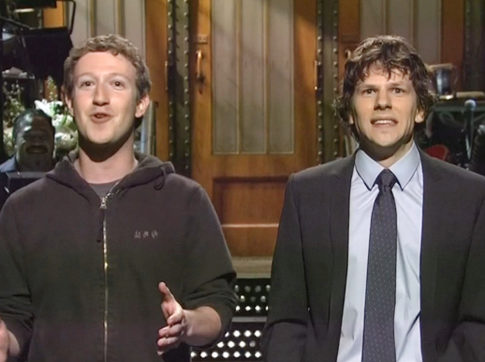
Zuckerberg followed in this tradition, appearing with Eisenberg on an episode of Saturday Night Live.


Steve Wozniak has an entire section of his website devoted to answering questions about Pirates of Silicon Valley. One of the points he makes interests me because it seems to reveal why Steve Jobs returned to make Apple a success once more, while Wozniak did little beyond his amazing early achievements. Asked about why Microsoft was given access to the Mac system, he explains that Microsoft made the best application software, and then goes on:
We did all realize by this time that the difference in computers, the thing that made some more special, was the software. Macintoshes and PC's had similarly capable hardware. But the Macintosh had the special OS and apps that worked that way. That was the reason why people bought Macintoshes. But, even though we openly said this, we ran Apple as a hardware company, because that's where the big revenues were. We were a software company pretending we were a hardware company.
We built factories and ordered parts and hired sales teams and set up distribution and sold our products. We had to handle surplusses that weren't sellable as well. We put out a huge investment. Let's say that the annual profits were $1B. Pretend that we spent $4B and brought in $5B. Not bad for a computer company. But you can look back and see that these profits were all due to people wanting the Mac OS. The way that screen looked and worked, with you instead of against you. You could just look and see how to do things, rather than remember it all (this was back a ways in time!). The only way people could buy this OS was to buy our hardware. So it was easy on paper to tell a convincing story that we were a great hardware company. And our $5B revenues put us well up on the Fortune 500 list of companies. It guaranteed Apple very high respect in big business circles.
But what if we'd just sold the OS to anybody who wanted to make hardware to run it. What if we'd even given up our hardware business. Let's say we licensed our OS. Assume that we'd have brought in the $1B it was worth (you could argue less but you could also argue more) every year. We'd only be a $1B company instead of a $5B company. Not as worthy, right? I'd like to suggest that this would have been better for our shareholders. The company wouldn't have had to take the huge investment risk, wouldn't have to set up factories that might be disposed of when things turned on us, wouldn't have had to melt down tons of unsellable hardware, wouldn't have been caught with lots of unused parts, wouldn't have had to hire and manage so many employees. We just could have sat back with a good programming team and collected on the Macintosh OS. We'd have been more like Microsoft. But this wouldn't have made us as big a company as selling hardware.
It seems that if we'd looked ahead at the importance of software, we'd have seen the mistake in this.

Looking at sales and profit charts (scroll to bottom of linked page) for Apple, we see an astonishing pattern: revenues went up steadily between 1981 to 1995, from a mere 335 million to a massive 11 billion. This indicates Apple had a great run for a decade after Steve Jobs was sacked in 1985. After 1995, though revenues declined precipitously, no doubt affected by the success of Windows 95. Again, this would seem to bear out Wozniak's analysis of Apple as a software company pretending to be a hardware firm. When Steve Jobs returned as CEO in 1997, sales were at 7 billion. Despite the success of the iMac, they kept going down till 2002, at which point they were at 5 billion annually. That's when an incredible resurgence began, helped by the Mac OS X, iPod, Apple Stores, iTunes, iPhone and iPad. Still, they only crossed the previous high sales mark in 2005, with sales of 13 billion. The chart then goes like this: 2006, 19 billion; 2007, 24 billion; 2008, 37 billion; 2009, 42 billion; and 2010, an incredible 65 billion dollars.
It was like something being torn down almost completely and rebuilt. The rebuilding was based on Apple's famed combination of well-designed hardware and intuitive software, which was finally affordable to a mass client base. Instead of Apple becoming more like Microsoft, Microsoft was left scrambling to become more like Apple. I don't know when Steve Wozniak wrote that comment about Apple essentially being a software company, but it must be evident to him now that a software company would never have been able to produce the devices that have made Apple the largest tech company in the world. Great engineer though he may be, it's clear Wozniak is no visionary. I wish Pirates of Silicon Valley had given some play to the creative side of Steve Jobs; the film would've been much better for it, and in some ways preempted The Social Network.