Showing posts with label history. Show all posts

Saturday, January 5, 2013

Jesus, money changers and money lenders

The Vatican has been barred by Italy from accepting credit and debit cards, because the Italians feel the city state does not have a proper legal framework to prevent fraud. This means visitors can pay only cash for souvenirs, and will put a major dent in the Vatican's tourism revenues. The Italians were sensible enough to let the Christmas high season pass before clamping down. Presumably the matter will be sorted out before Easter.
In covering the issue, reporters have reached for a Biblical analogy that seems most apt: the cleansing of the temple by Jesus. Reuters, for example, went with, "... the move has nothing to do with throwing money lenders from the Temple or concerns about usury." Which gives me an opportunity to segue into an issue that really interests me, misreadings of canonical texts (I'm not particularly concerned about sales of postcards in the Vatican).
Pretty much every Christian who goes regularly to church has been told about the story of Jesus whipping the money lenders and chasing them out of Jerusalem's great temple. It's the standard text to bring up in discussions about Christianity, usury and the history of anti-Semitism.


Yet, the actual incident has nothing whatsoever to do with money lending. Christian boys and girls have for centuries been fed a lie by their parents and priests (who, to be fair, probably act out of ignorance). By the time they mature, they cannot read what's before their eyes without substituting it with the incorrect interpretation they've been brought up to believe.
Here's the incident as told in the English Standard version of the Bible:
Matthew 21:12
And Jesus entered the temple and drove out all who sold and bought in the temple, and he overturned the tables of the money-changers and the seats of those who sold pigeons.
John 2:13-16
The Passover of the Jews was at hand, and Jesus went up to Jerusalem. In the temple he found those who were selling oxen and sheep and pigeons, and the money-changers sitting there. And making a whip of cords, he drove them all out of the temple, with the sheep and oxen. And he poured out the coins of the money-changers and overturned their tables. And he told those who sold the pigeons, “Take these things away; do not make my Father's house a house of trade.”

The phrase used is unambiguous: money changers, not money lenders.


When you think about it, Jerusalem's temple, where most visitors were pilgrims, would have been the last place where money lenders would've plied their trade. Lending to people you barely know, who are in town for just a couple of days, and who live in distant lands, is the equivalent of giving money away.
Money changing was a different trade altogether. It involved providing local currency to those who came in with Roman or Greek coin. It required experts who could tell counterfeit metal from the real stuff, who could gauge whether any corners had been cut (the phrase originating from the practice of physically slicing off slivers of precious metal from coins), and who were familiar with a variety of currencies. The money changers were the equivalent of today's shops with signage exclaiming EXCHANGE WECHSEL CAMBIO BUREAU DE CHANGE. They performed a necessary service, helping pilgrims, local traders and the temple. They kept the entire economy of the locality going, and took a cut for doing so.

Jesus wasn't against any one type of business; he was against the idea that any business at all should be conducted within a holy site. Of course, if priests and parents told children this, they might get asked whether Jesus really did the right thing. Did those petty traders deserve to be whipped and have their little work counters turned upside down? Presumably, if Jesus had gone in alone, the money changers would've banded together and kicked him out. It stands to reason that he was accompanied by a group of followers, though this isn't mentioned in the Bible, and is not how the scene is depicted in the paintings of Giotto and El Greco accompanying this post.

There's another question kids might ask, if told the truth about Jesus's action: since Jesus was so firmly against any connection between places of worship and any kind of commerce, why does virtually every famous church, whether Catholic, Protestant, or Orthodox, contain a shop selling souvenirs? Why is the Vatican hawking postcards in the first place?

Tuesday, April 3, 2012

Arundhati Roy, colonialism and the spectre of Marx


A number of respondents to my remarks on Arundhati Roy's Capitalism: A Ghost Story (see previous post) have accused me of not seeing the forest for the trees. No matter this or that error or mistaken detail, they say, her larger, abstract argument is valid. NGOs and charitable foundations have agendas (Hate using that word since, pedantically, agenda is plural of agendum, but 'NGOs have agenda' will come across as a typo. I have sworn, however, never to use criteria as a singular noun.) that are commonly determined by sponsors who are commonly anonymous and commonly fronts for governments.
I have no problem accepting the thesis outlined above, and neither, I believe, will anybody else reading it. It is verifiably, demonstrably true, but it is not what Arundhati Roy is claiming. She tries to knit a grand conspiracy in which governments, businesses and NGOs efficiently combine to serve the cause of Capital and Empire. The small errors in her argument are important because it is through these that she tries to weave in the ends of the fabric, and tugging at them causes the entire pattern to fall apart.
There were a couple of sentences from Roy's article that stuck in my mind, and I want to return to them as a starting point for a discussion about colonialism, postcolonial ideas and Marxism:

The era of the Privatisation of Everything has made the Indian economy one of the fastest growing in the world. However, like any good old-fashioned colony, one of its main exports is its minerals.
India’s new mega-corporations—Tatas, Jindals, Essar, Reliance, Sterlite—are those who have managed to muscle their way to the head of the spigot that is spewing money extracted from deep inside the earth.

Are minerals among India's main exports? The mining sector contributes only between 2 and 3% of GDP, so it's hardly central to the economy. Not quite what sugar was to the Caribbean or oil is to West Asia. We exported 128,000 crore rupees worth of minerals in 2009-10, and our total exports that year amounted to 845,000 crore rupees. OK, you say, that's a substantial percentage of total exports, but there's a catch. The biggest item in that export list is of diamonds, at 85,000 crore rupees. We also imported uncut diamonds worth 75,000 crore, and the same were then exported after being cut and polished. So, the export of minerals actually mined in India was a paltry 43,000 crore rupees, of which 28,000 crore rupees was iron ore. The second largest mineral export was granite at 5,000 crore rupees.
We imported 525,000 crore rupees worth of minerals in the same year, of which crude took a massive slice. But even leaving petroleum aside, India was comfortably a net importer of minerals, with coal and copper being our biggest buys. Now, does that still resemble "any good old-fashioned colony"?
Meanwhile, in the latest recorded year, India exported 290,000 crore rupees worth of software services, equaling nearly seven times our minerals exports (minus those re-exported diamonds) of 43,000 crore rupees. So much for us being a colony exploited for its raw materials. Not that today's major commodity exporters are akin to colonies in any case. Do Qatar, Russia, Australia, South Africa and Argentina seem like colonies to an impartial observer?

Roy hints at a widely accepted story about the economics of colonialism, a story told by my school history books and one seemingly accepted by Left, Right and Centre in Indian politics. It goes like this: India was a land famed for its artisans and manufacturing skills. The British discouraged indigenous Indian manufacturing and turned this country into a supplier of raw materials and a market for British finished goods. The textile industry is the paradigmatic example of this process: India's long-standing position as a world leader was undermined by imperial restrictions on sales, cotton was shipped from India to Lancashire and other British factory towns, and finished cloth produced in those places sold back to India.

Karl Marx was among the first to understand and condemn the process then underway. he wrote:
It was the British intruder who broke up the Indian hand-loom and destroyed the spinning-wheel. England began with driving the Indian cottons from the European market; it then introduced twist into Hindostan, and in the end inundated the very mother country of cotton with cottons. From 1818 to 1836 the export of twist from Great Britain to India rose in the proportion of 1 to 5,200. In 1824 the export of British muslins to India hardly amounted to 1,000,000 yards, while in 1837 it surpassed 64,000,000 of yards. But at the same time the population of Dacca decreased from 150,000 inhabitants to 20,000. This decline of Indian towns celebrated for their fabrics was by no means the worst consequence. British steam and science uprooted, over the whole surface of Hindostan, the union between agriculture and manufacturing industry.

Unlikely though it might seem, the writer of the Communist Manifesto was, between 1852 and 1863, the European correspondent of the New-York Tribune. His colleague Engels also contributed occasionally to the American rag. The passage quoted above, and most of Marx's other writing about India, appeared in columns written for the Tribune, which occasionally reveal a witty side to a man generally viewed as formidably stern (It's the facial hair does it):
That there is in India a permanent financial deficit, a regular over-supply of wars, and no supply at all of public works, an abominable system of taxation, and a no less abominable state of justice and law, that these five items constitute, as it were, the five points of the East Indian Charter, was settled beyond all doubt in the debates of 1853, as it had been in the debates of 1833, and in the debates of 1813, and in all former debates on India. The only thing never found out, was the party responsible for all this.
There exists, unquestionably, a Governor-General of India, holding the supreme power, but that Governor is governed in his turn by a home government. Who is that home government? Is it the Indian Minister, disguised under the modest title of President of the Board of Control, or is it the twenty-four Directors of the East India Company? On the threshold of the Indian religion we find a divine trinity, and thus we find a profane trinity on the threshold of the Indian Government.

Marx saw, as early as 1853, an emerging contradiction within Britain with respect to India. The extract below is long, but worth reading carefully, for it contains an analysis that has eluded most post-colonialists, and resulted in a skewed view not only of imperialism but of the relationship between Empire and Capital.
During the whole course of the 18th century the treasures transported from India to England were gained much less by comparatively insignificant commerce, than by the direct exploitation of that country, and by the colossal fortunes there extorted and transmitted to England. After the opening of the trade in 1813 the commerce with India more than trebled in a very short time. But this was not all. The whole character of the trade was changed. Till 1813 India had been chiefly an exporting country, while it now became an importing one; and in such a quick progression, that already in 1823 the rate of exchange, which had generally been 2/6 per rupee, sunk down to 2/ per rupee. India, the great workshop of cotton manufacture for the world, since immemorial times, became now inundated with English twists and cotton stuffs. After its own produce had been excluded from England, or only admitted on the most cruel terms, British manufactures were poured into it at a small and merely nominal duty, to the ruin of the native cotton fabrics once so celebrated. In 1780 the value of British produce and manufactures amounted only to £386;152, the bullion exported during the same year to £15,041, the total value of exports during 1780 being £12,648,616, so that the India trade amounted to only 1-32 of the entire foreign trade. In 1850 the total exports to India from Great Britain and Ireland were £8,024,000, of which cotton goods alone amounted to £5,220,000, so that it reached more than 1/8 of the whole export, and more than 1/4 of the foreign cotton trade. But the cotton manufacture also employed now 1/8 of the population of Britain, and contributed 1/12th of the whole national revenue. After each commercial crisis the East Indian trade grew of more paramount importance for the British cotton manufacturers, and the East India Continent became actually their best market. At the same rate at which the cotton manufactures became of vital interest for the whole social frame of Great Britain, East India became of vital interest for the British cotton manufacture.
Till then the interests of the moneyocracy which had converted India into its landed estates, of the oligarchy who had conquered it by their armies, and of the millocracy who had inundated it with their fabrics, had gone hand in hand. But the more the industrial interest became dependent on the Indian market, the more it fell the necessity of creating fresh productive powers in India, after having ruined her native industry. You cannot continue to inundate a country with your manufactures, unless you enable it to give you some produce in return. The industrial interest found that their trade declined instead of increasing. For the four years ending with 1846, the imports to India from Great Britain were to the amount of 261 million rupees; for the four years ending 1850 they were only 253 millions, while the exports for the former period 274 millions of rupees, and for the latter period 254 millions. They found out that the power of consuming their goods was contracted in India to the lowest possible point, that the consumption of their manufactures by the British West Indies, was of the value of about 14s. per head of the population per annum, by Chile, of 9s. 3d., by Brazil, of 6s. 5d., by Cuba, of 6s. 2d., by Peru, of 5s. 7d., by Central America, of 10d., while it amounted in India only to about 9d... Besides, they found that in all attempts to apply capital to India they met with impediments and chicanery on the part of the India authorities. Thus India became the battle-field in the contest of the industrial interest on the one side, and of the moneyocracy and oligarchy on the other. The manufacturers, conscious of their ascendancy in England, ask now for the annihilation of these antagonistic powers in India, for the destruction of the whole ancient fabric of Indian government, and for the final eclipse of the East India Company.

It's so obvious in retrospect, but till I read this passage in my late teens, I had swallowed the official story about the Raj lock, stock and barrel. If a nation's citizens are progressively impoverished, and the nation becomes merely a place to grow or dig out raw material to be exported for manufacture elsewhere, that nation and its citizens cannot simultaneously provide a flourishing market for finished goods.

You cannot continue to inundate a country with your manufactures, unless you enable it to give you some produce in return
.

Roy's vision of neo-imperialism, articulated in an article written a decade ago, mirrors the fallacy Indian history books perpetuate about the Raj:
Across the world as the 'free market' brazenly protects Western markets and forces developing countries to lift their trade barriers, the poor are getting poorer and the rich richer.

I have confronted this idea from a different perspective in an earlier blog post, but in the present context I want to underline the inherent contradiction within it, which Karl Marx's 159 year-old newspaper column exposes: if the poor keep getting poorer, lifting trade barriers is useless, since people on the other side of the divide will be incapable of buying any goods from those nasty Western neo-imperialists.

Sunday, April 1, 2012

Annotating Arundhati

Arundhati Roy raises a number of vital issues in her latest polemic Capitalism: A Ghost Story. She's at her strongest when describing the condition of places like Chattisgarh, where corrupt administrations have given over large tracts of land to industrialists through secret agreements; herded sections of the population into concentration camps; and created pro-government militias while branding all protestors Naxalites. Her larger criticism relates to think-tanks, philanthropic foundations and NGOs creating and maintaining a consensus about the way the world's economy ought to be run. I don't believe she's convincingly made the connection between the micro and macro picture. In fact, I find a number of her arguments faulty, error-ridden or plain dishonest. Here's a small sampling of those, with quotes from her essay in italics and my comments below these in normal type.

India’s 100 richest people own assets equivalent to one-fourth of the GDP.

While the figure is shocking, it is also a misleading apples-and-oranges comparison, because 'assets' relate to total wealth, while 'GDP' measures production in a single year.

In India, the 300 million of us who belong to the new, post-IMF “reforms” middle class—the market—live side by side with spirits of the nether world, the poltergeists of dead rivers, dry wells, bald mountains and denuded forests; the ghosts of 2,50,000 debt-ridden farmers who have killed themselves, and of the 800 million who have been impoverished and dispossessed to make way for us.

It is amusing to have Arundhati Roy include herself in the 'middle-class'. She's rich by any standards, a dollar millionaire many times over. There is, of course, a persistent belief among rich Indians that they are only middle-class, and to that extent Roy comes through, for once, as typically Indian.
The passage describes a zero sum game in which 300 million Indians have won at the expense of 800 million losers. There is, however, no evidence that those who are impoverished were better off in the past. India has for millennia been a land where most citizens lived in misery.

The era of the Privatisation of Everything has made the Indian economy one of the fastest growing in the world. However, like any good old-fashioned colony, one of its main exports is its minerals. India’s new mega-corporations—Tatas, Jindals, Essar, Reliance, Sterlite—are those who have managed to muscle their way to the head of the spigot that is spewing money extracted from deep inside the earth. It’s a dream come true for businessmen—to be able to sell what they don’t have to buy.

Roy focuses on mining throughout the piece, and this passage exposes a major fault line in her argument. Groups like the Tatas and Jindals are not among India's biggest exporters of minerals. They want mining leases to assure themselves of supply to their steel plants. There is a constant tussle, reflected in the minister in charge of mining battling the one in charge of steel, between indigenous manufacturers who want exports restricted and exporters such as Sesa Goa who want license to sell anywhere in the world. Roy's erroneous view of Capitalism as an efficient and single-minded monster cannot capture these conflicts.

... by now we know that the connection between GDP growth and jobs is a myth. After 20 years of “growth”, 60 per cent of India’s workforce is self-employed, 90 per cent of India’s labour force works in the unorganised sector.

Non-sequitur. The first sentence speaks about job growth as a whole, and the second shifts to self-employed and unorganised jobs versus organised ones. Has she considered that GDP growth might create opportunities for self-employed and unorganised workers? Sure, it would be good to have more organised sector employment, but that's prevented as much by outdated labour laws and short-sighted unions as by any failure in the market's functioning.

In the summer of 2011, the 2G spectrum scandal broke. We learnt that corporations had siphoned away $40 billion of public money by installing a friendly soul as the Union minister of telecommunication who grossly underpriced the licences for 2G telecom spectrum and illegally parcelled it out to his buddies.

The CAG's voodoo arithmetic has led to a lot of confusion, and Roy happily takes her place among the befuddled. She says corporations "siphoned away" 40 billion dollars of public money. No, they didn't. The money didn't actually exist. It is an estimate of what the government, in the GAG's view, might have earned, had it auctioned 2G licenses and spectrum, instead of following a first-come-first-served policy. The calculation of presumptive loss is itself seriously apples-and-oranges, using 3G prices as a benchmark to estimate 2G income. What laypeople don't seem to realise is that any money accruing to the government eventually comes from our pockets. If the government 'lost' 40 billion dollars, it was money that the telecom firms would have made back by charging us higher prices. Frankly, I'm happy the money stayed in our pockets and tariffs plunged so low that India ended up with the cheapest calling rates in the world.

Of late, the main mining conglomerates have embraced the Arts—film, art installations and the rush of literary festivals that have replaced the ’90s obsession with beauty contests... The Jindal Group brings out a contemporary art magazine and supports some of India’s major artists (who naturally work with stainless steel).

I was for a couple of years the editor of the contemporary art magazine Roy mentions. It was established before the Jindals owned mines. The Sajjan Jindal Group neither was nor is a 'mining conglomerate', but primarily a steel manufacturing business with interests in power generation. It is also wrong to claim the Jindal Group 'supports some of India's major artists (who naturally work with stainless steel)'. The artist most identified with stainless steel, Subodh Gupta, was part of a workshop in Jindal Steel's Vasind campus a decade ago. He has also featured regularly in Art India magazine. But those are very minor entries in his CV. I don't believe the Jindals have patronised any major, or even minor, artist, in the way, say, Harsh Goenka of the RPG Group has done. The Sajjan Jindal Group, by the way, does not manufacture stainless steel. Jindal Stainless is run by a different branch of the family.

But which of us sinners was going to cast the first stone? Not me, who lives off royalties from corporate publishing houses.

Wow, a moment of self-reflection after a decade and a half of pointing fingers. Though she says she won't cast the first stone, Roy chucks a number of missiles in the course of this diatribe. Since she's in an introspective mood, though, she might consider how her international travel would be possible without steel and oil; and how her home could be lit and her PC booted up without power from either burning coal, building dams, or splitting atoms.

What better way for usurers to use a minuscule percentage of their profits to run the world? How else would Bill Gates, who admittedly knows a thing or two about computers, find himself designing education, health and agriculture policies, not just for the US government, but for governments all over the world?

Bill Gates, who has donated far more than a minuscule percentage of his wealth to his Foundation, was among the most powerful men in the world long before he turned to philanthropy. Just because his foundation designs a few policies doesn't mean he runs the world.

Mohammed Yunus and the Grameen Bank brought microcredit to starving peasants with disastrous consequences.

Some of the sheen has come off the microcredit miracle, no doubt, but to suggest Grameen Bank has been a disaster is surely a mistake. Many of those starving peasants stopped starving as a result of access to credit.

The Ford Foundation established a US-style economics course at the Indonesian University. Elite Indonesian students, trained in counter-insurgency by US army officers, played a crucial part in the 1965 CIA-backed coup in Indonesia that brought General Suharto to power. Gen Suharto repaid his mentors by slaughtering hundreds of thousands of Communist rebels.

These kinds of statements most clearly demonstrate Roy's dishonest mode of argument. There are some chaps studying a course in economics designed by the Ford Foundation in Indonesia. A completely different group of 'elite students' supposedly plays a part in a CIA-backed coup. The details of the coup of 1965 have never been sufficiently revealed, but it appears to have been one faction of the army trying to take over the country and failing. I haven't read anything that suggests 'elite students' played a significant role in the operation or in the slaughter that occurred later. But by bringing anti-insurgent students into the picture, Roy creates a sense in our minds that the economics students have something to do with the coup, and, by extension, that the Ford Foundation was somehow involved in the Indonesian massacres of 1965 and 1966. But all the Ford Foundation had done was set up an economics course. It didn't kill any Communists, nor train anybody to kill Communists, nor even, as far as we can tell, train anybody in economics who later killed Communists.

Eight years later, young Chilean students, who came to be known as the Chicago Boys, were taken to the US to be trained in neo-liberal economics by Milton Friedman at the University of Chicago (endowed by J.D. Rockefeller), in preparation for the 1973 CIA-backed coup that killed Salvador Allende, and brought in General Pinochet and a reign of death squads, disappearances and terror that lasted for seventeen years.

More false history. The programme to train Chileans at Chicago originated in the 1950s. Salvador Allende gained power in Chile in 1970. In no sense or form were students from Chile taken to the US 'in preparation' for the 1973 CIA-backed coup. The Ford Foundation had no more to do with the coup in Chile than it did with the coup in Indonesia.

A conservative estimate of the UID budget exceeds the Indian government’s annual public spending on education.

Apples-and-oranges again. Roy appears to be comparing the UID budget for its entire multi-year rollout to an annual budgetary outlay. To provide a more accurate comparison, here are estimates for 2012-13 announced in Pranab Mukherjee's recent budget:
UID: 14232 crore rupees
Education: 48,781 rupees
Education, moreover, is a State subject, which means the total Indian governmental contribution to schooling is far greater than the 48,781 crores allotted by the Centre.

As US universities opened their doors to international students, hundreds of thousands of students, children of the Third World elite, poured in. Those who could not afford the fees were given scholarships.

The whole point of scholarships is to ensure that deserving students don't get left out just because they aren't part of the elite. Roy manages to twist this honourable aim to make scholarships part of a grand Anglo-American conspiracy to brainwash Third Worlders. "Those who could not afford fees were given scholarships" makes the entire grants process seem so easy from the recipients' perspective.

Armed with their billions, these NGOs have waded into the world, turning potential revolutionaries into salaried activists, funding artists, intellectuals and filmmakers, gently luring them away from radical confrontation, ushering them in the direction of multi-culturalism, gender, community development—the discourse couched in the language of identity politics and human rights.

Actually, for decades the billions poured into education programmes and cultural grants by the American government and its proxies failed to turn potential revolutionaries away from the path of radical confrontation. The real problem was that regimes that tried to do away with the market created far more misery and perpetrated far greater atrocities than the system they set out to replace. Eventually, most intelligent people understood that the practical failures of anti-capitalist governments resulted not only from sanctions, embargoes and CIA-sponsored insurgencies, but also from deep-rooted in-built drawbacks. Roy never acknowledges that long and bitter history of failure, except insofar as she purges her writing of anything that could be construed as a positive alternate vision.

Update, April 2: A couple of friends have pointed out that I come across as condoning the corruption of A Raja, and I can see why they see it that way. The 2G scandal is rather complicated, but, briefly, Raja's corruption involved getting firms licenses that would otherwise not have qualified under the established criteria, and blocking a couple of firms who would have qualified. He needs to be punished for this. My objection is to the idea that his acts constituted one of the greatest scams in India's history, a belief fed by the absurd 40 billion dollar figure the CAG dreamt up. Had the licenses been handed out sticking to procedure, the policy would have been preferrable in many ways to the auctions that are now going to be held for anything from spectrum to mining, following a recent Supreme Court verdict. Auctions tend to drive up prices for licenses to irrational levels, and hurt consumers because the costs are inevitably passed on to them.

Friday, March 9, 2012

Murder Incorporated


Syed Modi, who was born poor in a small town in Uttar Pradesh in 1962, broke free of his circumstances by excelling at badminton. He won the national championship at the age of eighteen, beating the great Prakash Padukone who was then at his peak. While junior national champion in 1978, Modi travelled to Beijing for an international tournament. A Bombay girl named Amita Kulkarni was in the women's team, and, as the Supreme Court would later record, "there arose intimacy between the two". Neither the Modis nor the Kulkarnis were thrilled with the idea of the North Indian Muslim boy marrying the upper-class Marathi girl, but the couple resisted family pressure, and wed six years later.
They had a daughter not long afterwards and, while Amita's badminton career was put on hold, Syed continued to rack up titles, winning his eighth consecutive national trophy in 1987. In July 1988, Modi was heading home after a practice session when he was shot dead on a street outside the K D Singh Babu stadium in Lucknow.
The UP police made little headway with the case, and the CBI was called in. They found an eye-witness who had not only seen the shooter but recognised him. They discovered that Amita Modi was having an affair with a state minister named Sanjay Singh, who was descended from the erstwhile royal family of Amethi. Sanjay Singh, in the CBI's view, had instructed a goon-politician named Akhilesh Singh to get Syed Modi killed. Four people were arrested for committing the murder, and Sanjay and Amita spent a small time behind bars. A few months after Modi's death, Sanjay Singh, who had a wife named Garima, married Amita Kulkarni-Modi. He didn't feel the need to hide the relationship, though it was the only imaginable motive behind the murder of a man whose friends described him as a mild guy with no enemies. By 1990, Sanjay Singh had left the Indian National Congress and was a central minister in V P Singh's new government (Sanjay and V P Singh were related). He later moved to the BJP and then back to the Congress. He's currently a Congress MP, but is showing signs of wanting to defect again. His wife, Amita Singh, just lost the election for the state assembly from Amethi, a stronghold of the Gandhi family dating back to the Indira Gandhi days.
It's obvious from this account that Sanjay and Amita were not convicted of plotting to murder Syed Modi. After making bold announcements of having cracked the case, the CBI began chasing its own tail instead of making any further headway. Last year, the former CBI Director Sumit Kumar Dutta published a memoir called Top Cop Recalls. He wrote, about the Syed Modi case: "One day, I received a telephone call from an officer close to the Cabinet Secretary that hearing for framing of the charge in the case was being preponed from the day already fixed for hearing and I should agree to it and not oppose the move. I said that it was not possible as our special counsel was in Mumbai and it was not possible for him to come earlier as there was no time for that.... next thing that came to my notice was that the Director was told to change our special counsel...".
Dutta and the then CBI Director Rajendar Shekhar resolved not to let political interference cloud the case. "He (Shekhar) told me that the Government wanted to know whether the Director would change the counsel. He wanted my views. I told him it was not possible in principle. He agreed with me. He asked me if I was prepared to put in my papers if the counsel was changed. I said ‘yes.’ He felt happy, as he too had decided to do so...Next thing that happened was something unheard of. All of a sudden, in the name of economy, the Government issued an order cancelling the appointments of all special counsels engaged by various departments to deal with their court cases. Therefore, our special counsel’s appointment was automatically terminated. All were surprised, but did not know the real reason."
When the Syed Modi case came to court, all the accused were let off, apart from the shooter identified by the eye-witness. Two acquitted underlings were soon found shot to death themselves. Needless to say, those murders have never been solved.
Sanjay Singh was in the news a few months ago, opposing his own party's decision to allow foreign investment in retail. Singh said the measure would hurt the poor, who are always foremost in his mind. Amita just gave an interview to NDTV speaking of how times have changed and dynasties like the Gandhis don't matter any more. The two will doubtless be welcomed into whichever party they decide to join next.
I've met taxi drivers from the Amethi region who speak of Sanjay Singh's power. Locals, they say, might be beaten for even looking him in the eye, men have to keep their head bowed in his presence. Syed Modi obviously got uppity, and paid the price.

Monday, February 6, 2012

Sharada Dwivedi

Just days after I mentioned Bombay: The Cities Within as a landmark book, comes the news that Sharada Dwivedi, co-author of the volume along with Rahul Mehrotra, has died. Sharada did as much as anybody to raise awareness about the city's built heritage, and to remove the post-colonial and chauvinistic ideological blinkers that had for decades prevented a celebration of that heritage. Her steady, sensible, and committed advocacy will be deeply missed.

Sunday, December 18, 2011

Fifty years of the Goa annexation

Fifty years ago, five centuries of Portuguese dominion in Goa was brought to an end by an Indian invasion, at the cost of less than sixty lives, divided more or less equally between Indian and Portuguese forces. My uncle (father's elder brother) was a young air force pilot at the time, and, years later, he told me of his role in the operation.
He had flown a transport to Goa to evacuate Indian soldiers after the battle. News from the war zone was sketchy; there were reports the airport had been shelled. From the sky, the airstrip looked badly cratered, except for the first third of it, which appeared normal. My uncle aimed for the verge of the airstrip and hit the emergency brakes as soon as the aircraft's wheels touched the ground. He managed to get the machine to stop before the battle-scarred zone.
My memory isn't perfect at this point, but if I recall right, my uncle said there was a problem getting the plane to restart because of the emergency procedure he'd employed. It took him nearly as long to get to the building where armymen were waiting, as it had to fly from Bombay to Panjim. The victorious Indian soldiers appeared to have emptied Goa's liquor stores. Each soldier was carrying crates of rum, whiskey and feni. Once the men and booze were on board, the plane took off from a state that was now part of India.
The emergency brakes had been unnecessary. What had appeared to be damage from artillery shells was just asphalt patch-ups on a concrete runway.
When I land in Goa these days, I notice they still use asphalt to repair the runway, and the strip still looks battle-scarred when viewed from the air.

Saturday, December 10, 2011

The army's special powers and Lord Curzon

Yesterday, on the eve of Human Rights Day, Clark House (an arts initiative run by Zasha Colah and Thakur Sumesh Sharma), Tushar Joag and Sharmila Samant put together a programme of screenings and discussions titled Against AFSPA at the National Gallery of Modern Art. Apart from a demand for the repeal of the Armed Forces (Special Powers) Act, it was an act of solidarity with Irom Sharmila, who has been on a fast for over a decade in protest again the repression of Manipuri citizens by the Indian army and paramilitaries. She has been held captive for attempted suicide and force-fed for all these years.
I was pleasantly surprised that an event so harshly critical of Indian state policy was taking place inside a government-run institution. Maybe the NGMA Director Rajeev Lochan's bureaucratic exterior conceals a radical, subversive agenda.
The proceedings were chaotic, bearing only a passing resemblance to the schedule provided on the invite. But they did a good job of demonstrating how insanely cruel the Indian government has been and continues to be to the people of Manipur. For over fifty years, an emergency law has been in place permitting soldiers to arrest, rape and kill with impunity. Mihir Desai, a participant in a panel discussion about AFSPA, and the only person on stage who spoke cogently, pointed out that any prosecution of soldiers needed central government sanction; and that, from over 500 cases forwarded to Delhi for consideration (I forget the exact number Desai mentioned, I think it was 581), not a single trial has been green-lighted.

I thought of Lord Curzon who, at the end of the nineteenth century, had a series of run-ins with the British army. Soon after he arrived in India as Viceroy, he heard that soldiers from the West Kent Regiment had gang-raped a Burmese woman. The perpetrators had gone unpunished after witnesses were threatened, and the matter covered up. Curzon had the culprits dismissed from the army and the entire regiment transferred to Aden (a punishment posting in those days) and denied leave or benefits for two whole years.
In 1900, after a private in the Royal Scots Fusiliers battered to death a 'punkah-coolie' (a man who operated cloth fans), Curzon wrote: "That such outrages should occur in the first place in a country under British rule; and then that everybody, commanding officers, officials, juries, departments should conspire to screen the guilty is, in my judgment, a black and permanent blot on the British name. I mean, so far as one man can do it, to efface the stain while I am here.”
In 1902, three troopers of the 9th Lancers Regiment (a cavalry outfit packed with members of the British upper class), just arrived in Sialkot, beat a cook named Atu so badly that he died after nine days of agony. Curzon lashed out at the biased investigation which, he wrote, "Consists of two Captains and a subaltern, not one of whom so far as I can make out, understands a word of Hindustani. Their idea of taking evidence and holding an inquiry consists in examining four witnesses, all natives. They never think of sending for the doctor or for a non-commissioned soldier or for the inspector of police. In fact they make not the slightest effort to arrive at the truth... I will not be a party to any of the scandalous hushing up of bad cases of which there is too much in this country, or to the theory that a white man may kick or batter a black man to death with impunity because he is only a 'd- d nigger'.”

Some day we might get a leader in Delhi who has the courage and moral conviction to hold soldiers responsible for a few of the innumerable atrocities perpetrated in Kashmir and the North-East over the past decades. Right now, we can't even provide the millions of citizens living under AFSPA as much protection from the army's cruel excesses as the British colonial system did.

Thursday, August 11, 2011

Stray thoughts on the London riots

The British government has spent over half a billion pounds on street cameras, and London has perhaps more CCTV cams than any other city on earth. A couple of years ago, there were complaints that the crime-solving assistance provided by these cameras did not justify the expense involved in installing and maintaining them and the invasion of privacy that resulted from citizens being watched all the time.

Now, CCTV cam footage is going to lead to hundreds of convictions. I don't understand why people would loot shops in London. Surely they knew they'd be caught on a CCTV feed?

Many of the rioters certainly knew, which is why they wore masks and hoodies. So will there be calls for hoodie bans, like there have been calls for burqa bans?

If the Arab Spring was a Facebook and Twitter revolution, were these Facebook and Twitter riots? How does the Social Media shoe feel on the other foot?

The rioters (I'm differentiating these from opportunistic looters) appear mostly Afro-Caribbean, with a substantial infusion of White working-class / underclass youth. The vigilantes seem to be Asian (Turkish, Indian, Pakistani), East European and English. Strange coalitions, very distant from the world of My Beautiful Laundrette and Sammy and Rosie Get Laid.

I've always felt the partnership between activist Blacks and Asians formed in 1960s and 1970s Britain was flimsy. Maybe it was appropriate to that era, but it's broken down substantially since then, and is surely dead now. I don't see much common cause between the two ethnic groups anymore.

South Asians have serious problems to overcome: a conservative culture that does not respect free speech; a fealty to arranged marriage that can lead to forced marriages; extremism among Muslims that becomes terrorism at its most extreme. Afro-Caribbean Brits have a completely different set of issues to deal with: the breakdown of the family; drug use linked to violent crime; and low educational and economic attainment.

I can't understand why Britain has both a debt problem as well as an investment deficit after twelve years of Labour-led economic growth accompanied by high tax rates. Where did all that money go? I know we've been through a meltdown, but Gordon Brown's economy should've been better prepared for it. After all, there was no Blair tax cut to compare with the Bush tax cut.

One of the golden rules of party politics is that riots help the Right. They helped Nixon, Thatcher, Thackeray, Modi and Sarkozy, and will now help David Cameron, who appears really angry that his Tuscan holiday was interrupted.

It's good to see London cleaning up the mess. When citizens there come together to clean up, they do it in their thousands. It's different in India. Here, a few dozen meet, spend most of their time posing for cameras and leave the tough stuff to those meant for that kind of thing, if you get my drift. All acts in India are symbolic, even our recent 'Slut Walk', which consisted of about a hundred women dressed in standard Delhi college-girl clothes; a bunch of LGBT activists, mostly men; and about three hundred mediapersons fruitlessly seeking somebody slutty-looking to film.

India must be wishing the Edgbaston Test had been cancelled. I don't believe any World No.1 Test team has been at the receiving end of such a hammering in the past.

A few people have commented on the irony of an Indian tour of England been threatened by mob violence. It's supposed to be the other way round. The great example of playing cricket in troubled times must be England's 1984-85 tour of India.


This is a picture taken at Heathrow airport, on October 30, 1984, of David Gower and Allan Lamb boarding a flight to India at the start of that tour. They landed in New Delhi the next morning, just hours before Prime Minister Indira Gandhi was assassinated by Sikh bodyguards. The killing was followed by the worst sectarian bloodbath since Partition. The English cricketers stayed in their hotel before moving out to Sri Lanka, which had barely recovered from an even worse killing campaign. They flew to Colombo on Sri Lankan President Junius Jaywardene's private plane; he was returning from Indira Gandhi's funeral.
After playing warm-up games in Sri Lanka, the cricketers headed to Bombay for the first Test on November 28. On November 26, they attended a party thrown in their honour by Percy Norris, the British Deputy High Commissioner. The next morning, Percy Norris was shot dead not far from his Nariman Point office while being driven to work. The murder has never been solved, but it appears to have been an act of international terrorism, possibly masterminded by Abu Nidal, whose faction was demanding the release of three colleagues held in Britain.
It wasn't surprising that England lost that first Test at the Wankhede stadium.

Just as the match was winding down, Bhopal was struck by the worst industrial disaster in history. 1984 was definitely not a good year for India.

The tour went on, though, and the second Test was played in Delhi, which had returned to calm. England recovered to win that test, and went on to grab the series 2-1.


Tuesday, August 2, 2011

Xinjiang: Who's your mummy?

When Indian reporters question visiting Pakistani politicians about the Kashmir issue, they usually assume the Indian establishment's point of view. I've always felt these chaps didn't ask questions that would really put Pakistani leaders in a spot. I have not, for instance, come across any reference to China's Xinjiang province in interviews with the likes of Nawaz Sharif and Pervez Musharraf.
Xinjiang is a mainly Muslim, ethnically majority Uighur province in China with a separatist movement that Beijing tries hard to suppress. Since China is one of Pakistan's closest and most important allies, Pakistani leaders will never say a word in favour of separatists in Xinjiang.
So, when a Pakistani President or Prime Minister or Foreign Minister says, "We believe in the right of self-determination for Kashmiris", it might be worthwhile asking, "Do you also favour the right of self-determination for Uighurs in Xinjiang?". It'll be fun watching the interviewee trying to wriggle out of that spot.
Xinjiang and the Uighurs are likely to force themselves into the lexicon of Indian reporters following a news item yesterday that China has blamed separatists trained in Pakistan for a terrorist attack within Xinjiang. Pakistan, of course, immediately condemned the attack, but will have to do more than condemn it to placate the Chinese.

As an unrelated aside, Xinjiang, like many of the earth's driest places, has revealed an old tradition of mummification, dating back four thousand years. The Xinjiang mummies, or Tarim Basin Mummies are unusual because the oldest dessicated bodies show distinctly Caucasoid features. It seems like the first inhabitants of Xinjiang rode in from Europe, and were gradually joined by East Asians. The Uighurs only migrated to the area in the 9th century, which, if I recall correctly, is also around the time Turks first got to Turkey.

Monday, June 20, 2011

Talking Turkey

My column this fortnight is about shifts in Turkey's perception of itself and its place in the world. Read it here.

Monday, June 6, 2011

It's the army, stupid.

My latest Yahoo! column explores why India remained democratic when so many developing countries were taken over by dictators. Read it here.

I've been off the blog for a while, but promise to post more often in weeks to come.

Monday, May 9, 2011

Osama, icons and iconoclasm

My Yahoo! column today is about Bin Laden, Wahhabis and Puritans, icons and iconoclasts. Read it here.

Tuesday, April 12, 2011

My Yahoo! column is back

After a hiatus for a tech overhaul, the Yahoo! India columns are back. My first piece went online yesterday. It is about chocolate, bananas, oil and war. Read it here.

Thursday, December 30, 2010

Rasta to Zion, cut and paste

Bobby Farrell, of Boney M died in St.Petersberg yesterday, in his hotel rather than during a performance of Rasputin. I wrote a column about Boney M and geopolitics a few weeks ago, but since Yahoo! is in the midst of a reorganisation, and all our columns have temporarily gone off line, I'm cutting and pasting the piece here.

Rasta to Zion

The Palestine International Festival of Dance and Music, designed to draw attention to water shortages in the West Bank, isn’t exactly the hottest ticket on the global performance circuit. The only reason the disco band Boney M’s gig in Ramallah gained coverage was that organisers asked the band not to play one of its greatest hits, Rivers of Babylon. The lyrics, derived from the Old Testament’s Book of Psalms, are words spoken by Jews lamenting their exile from Jerusalem, which is frequently referred to in the Bible as Zion:

By the rivers of Babylon, there we sat down

Yeah we wept, when we remembered Zion.

When the wicked

Carried us away in captivity

Required from us a song.

Now how shall we sing the Lord's song in a strange land?

Any mention of Zion is a tricky matter in the Arab world, where the state of Israel is frequently disparaged as ‘the Zionist entity’. The Wachowski brothers discovered this when their film The Matrix Reloaded was banned in Egypt. The authorities claimed they objected to the portrayal of a Creator, but the real problem probably lay with the rebel stronghold in the movie being named Zion.

The Wachowskis, aware they might be labelled Zionist propagandists, had taken precautions, like putting the rebel leader Morpheus in charge of a ship called the Nebuchadnezzar. That gentleman was a king of Babylon who conquered Jerusalem in 597 BC, and returned to crush a revolt a decade later. The Jews captured or driven into exile in this period constituted the first Diaspora. Nebuchadnezzar may have constructed one of the wonders of the ancient world, the Hanging Gardens of Babylon, but it counted for little in the minds of those who composed the Bible. There, he is forever the wicked king carrying the Chosen into captivity. It is commonly held that history is written by the winners. The Old Testament appears to disprove that theory, as do a few Rajput tracts I know.

Despite the bad notices in the Holy Book, Nebuchadnezzar has attracted his share of fans down the ages, like a certain Saddam Hussein who dreamt of becoming the second ruler from what is now Iraq to conquer Jerusalem. Unlike his predecessor, however, Saddam was a mediocre general. The Nebuchadnezzar division of his Republican Guard found considerably less success in battle than the Nebuchadnezzar of the Matrix series, leave alone the army of the ancient Babylonian king.

Those who saw The Matrix Reloaded might have noticed a preponderance of dreadlocks at the dance party within the rebel camp before the crucial battle. This arguably echoes a different tradition of longing for Zion, Rastafarian rather than Jewish.

The Rastafarian faith traces its origins to the Jamaican activist Marcus Garvey, who launched a Back to Africa movement in the early twentieth century. In one of his more fervid speeches, Garvey proclaimed, “Look to Africa for the crowning of a Black King; he shall be the redeemer”. When, some years later, Ras Tafari Makonnen became Emperor Haile Selassie of Ethiopia, it was interpreted by many Jamaicans as the crowning Garvey had spoken about. In Rastafari theology, Haile Selassie, who claimed descent from Solomon and the Queen of Sheba, came to be regarded an incarnation of Jesus. Ethiopia was considered Zion, the land to which the African Diaspora would return from its exile in Babylon, variously seen as Jamaica or the West.

Ethiopia, the Promised Land? What were those guys smoking, you might ask. The answer is: preparations of Cannabis Indica, a plant indentured labourers from the subcontinent introduced to the Caribbean. Rastafaris believe, as do some dreadlocked sadhus, that ganja has spiritual properties. Smoking it is a sacrament.

The songs of the most famous Rastafari convert, Bob Marley, are saturated with the political and philosophical beliefs of the movement. When Marley sings Iron, Lion, Zion or Zion Train; or when he speaks in Exodus of leaving Babylon and returning to the fatherland; he’s referring to places outside Israel and Iraq, and even Asia. This is also true, as it happens, of Rivers of Babylon, originally recorded by the Rastafarian reggae group The Melodians before being covered by Boney M in a version that achieved worldwide success.

Maybe that’s what Maize Williams of Boney M should have told the organisers of the Palestine festival. It’s not Jerusalem the people in my song are remembering, it’s obviously Addis Ababa. There’s more than one Zion in the world.

There’s also, as it turns out more than one Boney M in the world. There are as many Boney Ms, in fact, as there were members in the band’s line-up in the late 1970s. After disco collapsed as precipitously as Arab defences had during the 1967 war, the group spent years in the wilderness before the nostalgic revival of the early 1990s brought them back to the limelight. Each of the four toured separately as Boney M; the only problem was, just two of the four had ever sung a word in the band’s studio records. The other two were there to dance attractively and lip sync in concerts. Maizie Williams, who rocked Ramallah a few days ago, is one of the non-singers. How would she sing the Lord’s song in a strange land? Out of tune, unless helped by backing vocalists, with the volume turned low on her microphone.

Monday, October 18, 2010

Lonely Planet's Islamophobia


My Yahoo! column this week focuses on errors and biases in Lonely Planet's wildly popular India guide. Read the piece here.
A couple of years ago I emailed Lonely Planet, pointing out some of the errors mentioned in this article. I received no response, and when the new edition arrived I found it carried most of the same mistakes.

Monday, October 4, 2010

Down the Drain

My Yahoo! column this fortnight is gutter journalism. Well, it's about drains and sewage and suchlike. Read it here.

Monday, July 26, 2010

Rasta to Zion


The Palestine International Festival of Dance and Music, designed to draw attention to water shortages in the West Bank, isn’t exactly the hottest ticket on the global performance circuit. The only reason the disco band Boney M’s gig in Ramallah gained coverage was that organisers asked the band not to play one of its greatest hits, Rivers of Babylon.
Read the rest of my Yahoo! column here.

Tuesday, May 4, 2010

Memories and Memorials

Here's the text of my Yahoo! column without the minor editorial changes made before its publication.


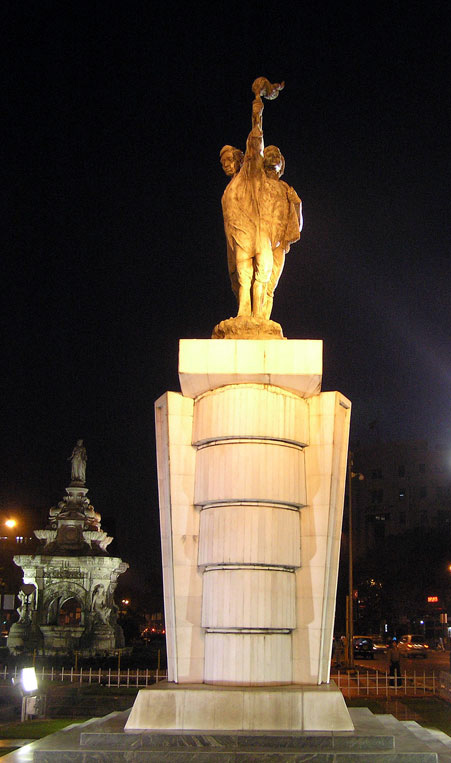
The bronze statue at the martyrs’ memorial in South Bombay stands on a peculiar, somewhat cone-shaped pedestal. Perhaps the designer’s intention was to mimic the form of a torch, with the pedestal as its handle and the statue as the flame. That’s the only explanation I’ve been able to dream up, having given the matter considerable thought.
The pedestal could be overlooked, if the sculpture itself made a powerful impact. The composition consists of a loin-cloth clad farmer fused to a kurta wearing city dweller. The two jointly hold a mashaal that resembles a fly whisk. While the farmer is comfortable in his pose, his partner looks distraught, perhaps because he is being nudged off balance and risks toppling from his perch. It must be particularly galling for him to be in that position because, after all, few loin-cloth wearing farmers lost their lives in the push for the creation of Maharashtra. It was people in urban areas who suffered, particularly citizens of Bombay which was the flashpoint of the five year long agitation. After first attempting to forge a bilingual entity, Jawaharlal Nehru proposed a three way division, in which Gujarat and Maharashtra would be fully fledged states while Bombay was ruled directly by the Centre. The Samyukta Maharashtra Samiti rejected this notion out of hand, and took to the streets in protest.
Those protests have now largely passed from history into legend. The myth has grown that peaceful demonstrators came out on the streets in January 1956, and were shot in cold blood by police under the orders of Morarji Desai. In some accounts, the firing takes place in 1960, although Desai had moved to the Central government by then. We read versions of this tale in commemorative supplements from newspapers:
“Hutatma Chowk: a sculpture set up in memory of the 105 deaths that occurred in 1960 when a peaceful demonstration by the Samyukta Maharashtra Samiti (United Maharashtra Committee) was fired upon by the police.”
In blogs:
“During one peaceful protest in 1956, under the auspices of Morarji Desai’s Congress government in Bombay state, police opened fire and killed 105 people.”
In encyclopedias:
“In January 1956, demonstrators were fired upon by the police at Flora Fountain in the capital city of Mumbai. Flora Fountain was subsequently renamed Hutatma Chowk or "Martyr's Crossroads" in their memory. It is estimated that in all, 105 people were shot by security forces. Morarji Desai, who was the then chief minister of Bombay state was later removed and replaced by YB Chawan as a result of criticism related to this incident.”
And on NGO websites:
“In January that year, police fired upon participants of a peaceful demonstration at Flora Fountain. 105 people died in the firing. Flora Fountain was subsequently renamed Hutatma Chowk and a memorial was built in their memory.”

An alternative myth, which has the advantage of being amusing, is found in Salman Rushdie’s Midnight’s Children. The young Saleem Sinai, trying to impress a girl with his bicycle-riding skill, hurtles into a Samyukta Maharashtra Samiti procession. After being jeered for his evident affluence, he’s prompted to speak in Gujarati, at which point he says the only words he knows in that language: Su che? Saaru che. Danda leke maaru che; translated as: How are you? I am well. I’ll take a stick and thrash you to hell! The rhyme becomes a war chant for the Marathi marchers, who surge forward, encounter a counter-procession of Gujaratis, and lay into them, sparking language riots which lead ultimately to the creation of Maharashtra and Gujarat.
In truth, Saleem Sinai was not a cause of the foundation of Maharashtra, but neither was a massacre of unarmed, peaceful demonstrators. Hutatma Chowk has 106 names etched on a slab some distance from the bronze statue; it is clear from the inscription that they died on different occasions and at different places. A number of the names are not Marathi: there’s a Patel, a Cursetjee, and a Singh among others. The strongest argument against the martyr myth, however, concerns not the time or place or mother tongue of the dead, but the manner of their protest. A Time magazine report dated January 30, 1956, describes the peaceful activists thus:
“The rioters blocked streets with boulders and gasoline drums, tore up lampposts, ripped down fences. They smashed statues of Mahatma Gandhi (a Gujarati himself), burned Desai in effigy, flourished pictures of Nehru hung with old shoes as a gesture of despisal. Mobs, sometimes 10,000 strong, stormed police stations, looted Gujarati shops, flung electric light bulbs filled with nitric acid in the faces of police and passersby. Saboteurs derailed trains, hurled stones at buses, set fire to cars.” In this context, the torch held by the two bronze figures at Hutatma Chowk acquires a very different meaning.
It wasn’t just riots that changed Nehru’s mind about keeping Bombay separate from Maharashtra. The losses the Congress suffered in the 1957 elections played a crucial role. The coalition opposed to the Congress was composed mainly of Leftist politicians. Socialists and communists like S M Joshi, S A Dange and Lalji Pendse viewed the language divide between Marathis and Gujaratis as a mirror of the division between proletariat and bourgeoisie, and ignored the warnings of Nehru who believed their agitation would encourage linguistic chauvinism. May 1, Labour Day, was chosen as the date Maharashtra would be born because of the Left’s conviction that the inclusion of Bombay in the state represented a victory of the working class. They soon learned how wrong they were. After 1960, demands began to be made for Marathi quotas in the public and private sector. The Shiv Sena, created in 1966, drove a wedge in the workers’ movement by pandering to the frustrations of bhumiputras. Within ten years of the formation of Maharashtra, the Left had been sidelined in Bombay trades unions and state party politics.
There are many reasons to celebrate the fiftieth anniversary of Maharashtra’s birth. In the broader context, the division of states along linguistic lines did not produce the worst results imagined by the idea’s detractors. If anything, as Ramachandra Guha convincingly argues in his book India After Gandhi, it helped quiet secessionist rumblings. It remains the case, however, that not only does the Hutatma Chowk martyrs’ torch carry two significations, of liberty and destruction, but the nature of Maharashtra’s genesis has made it impossible to separate one from the other.

Monday, May 3, 2010

My new column

I have just commenced a fortnightly column for Yahoo! India. The column is called Anything That Moves, and the first piece, titled Memories and Memorials, has just been uploaded and can be accessed here.

Friday, February 19, 2010

Akhenaten, monotheism and realism


Tutankhamun's daddy, Akhenaten, is known as the heretic Pharaoh. The son of one of Egypt's great rulers, Amenhotep III (or Amenophis III), Akhenaten presided over a downswing in the empire's fortunes. How much he contributed to the decline is a matter of debate.
He's known mainly for raising Aten, the sun god, to the status of chief deity. This was resisted by powerful priests in charge of temples of other gods, which led Akhenaten to abandon the old capital and shift to a new city, named Akhetaten, and now called El Amarna.
The house altar pictured above, shows Akhenaten with his chief queen Nefertiti and three of their six daughters. It's almost the only example in Egyptian art of a Pharaoh depicted in such an informal context. Friezes and paintings from this period are very different in spirit from what came before and after. They show ordinary people going about ordinary things. Strangest of all, they show a Pharaoh who is no remote ideal. Akhenaten has an elongated skull, a saggy abdomen and, in a number of statues, man breasts.


Akhenaten gained a massive reputation in the late 19th and early 20th centuries. This was mainly because his exclusive worship of Aten was interpreted as monotheistic. Rather than an eccentric, he was seen as a rebel against the power of the priesthood. A man who gave his queen equal status, he could be see as almost a democrat. For Europeans who saw monotheism as the most sophisticated form of worship, and democracy as the most just form of politics, Akhenaten was the only Egyptian ruler who approached these ideals.
H.R.Hall called him the first example of a scientific mind, James Breasted termed him the first individual in all of history, and Sigmund Freud, in his book Moses and Monotheism, suggested Moses was a priest in Akhenaten's time, who was banished from Egypt after the Pharaoh's death, and founded Judaism on the basis of Akhenaten's monotheistic ideal.
If a chap was a monotheist, and a scientific mind, and a democrat, and a rebel, what artistic ideal would he adhere to? To a 19th century European, the answer was obvious: such a ruler would favour Realism, the most rational and democratic of styles. There was evidence enough of Akhenaten's realistic bent of mind in those casual royal images and the unflattering way he was portrayed.
Following this train of thought, experts took the friezes and statues of this period as accurate representations, and built theories based on them. If Akhenaten looked weird in paintings, it was because he looked exactly like that in real life. Why would he look like that? Froelich's syndrome was the first diagnosis. Problem was, Froelich's syndrome made people sterile, and Akhenaten, as seen in that image with Nefertiti, had quite a few children (six daughters with Nefertiti, and two sons with his other queen, his sister Kiya. One of the sons was named Tutankhaten, changed to Tutankhamun after worship of the god Amun returned to the mainstream).
Two years ago, a Yale university physician, Irwin Braverman, suggested Akhenaten's suffered from Marfan's syndrome, which is associated with long, curved fingers, a cleft palate, and an elongated skull. The latest tests have confirmed the cleft palate, and the longish skull, but have eliminated the possibility that Marfan's syndrome was to blame.
What's interesting to me is the idea that the art of Akhenaten's time was realistic. Didn't people notice he wasn't the only person who was shown with a saggy belly and long face? Not just his wives, but his kids had those features as well. Scholars explained this away by saying that, since Pharaohs married sisters, the same defect probably ran in the family. The problem with this is that the most famous sculpture to survive from ancient Egypt, a bust of queen Nefertiti, has her looking more like a supermodel than a Marfan's syndrome victim. It was among the unfinished works found in the studio of the royal sculptor Tuthmose, which explains the unpainted left eye.


This sculpture is on display in Berlin, as is the frieze at the top of this page, which shows Nefertiti in a rather different light. Which of the two is more realistic?
Once we get over the realism hurdle, one can see the art of Akhenaten's reign for what it is: clearly the inferior of work created in the time of many other Pharaohs, except in the last years when Tuthmose produced some marvels. Just because Akhenaten looks mis-shapen doesn't mean we should admire his sculptures more than we admire those of his father Amenhotep III.
Akhenaten's democratic attitude also crumbles on close inspection. He forced citizens to pray to Aten, abandoning the worship of their traditional gods. How liberal is that?
As for his monotheism, it wasn't exactly what scholars made it out to be. He never claimed Aten was the only God, merely that no other god should be worshipped. Akhenaten was a bit like a staunch Shaivite, who acknowledges the existence of divinities other than Shiva, but insists on Shiva's superiority, and will pray only to Shiva.
So he wasn't a realist, he wasn't a democrat, he wasn't a proper monotheist, he certainly wasn't a patron of Moses, that is a complete red herring dreamt up by Freud. He was an idiosyncratic king, probably not a very efficient ruler, who makes for an interesting diversion from the sometimes boring pomp and grandeur of the Pharaohs. Prejudices about the best form of worship and the best style of art raised him far above his station, and led to some wild theories which presumed everything in sculptures and paintings dating from his reign was an accurate representation. It wasn't. Now CT scans and DNA tests are confirming the fact that those portraits are stylised just like everything else in Egyptian art.