Sunday, August 21, 2011

Hakkasan Bandra

I dined at the Mayfair Hakkasan two years ago courtesy of Dinesh and Minal Vazirani of Saffronart. It was after a discussion on 'Junctures and Departures: Locating Modern and Contemporary Indian Art' at Saffronart's Bond Street gallery. I recall the food being good though not exceptional. What struck me most about the space was how crowded it was. Also, the waiters going around asking each diner about food allergies.
I've also dined at the restaurant which used to occupy the space where Hakkasan, Bombay, is now located. It was called Seijo and the Soul Grill, and its main dining area was demolished the day after we ate there. I believe that was a coincidence.
Apparently, Hakkasan has fulfilled license requirements by building a completely retractable roof, so it's unlikely to face the same fate as Seijo. It looks sturdy enough to make a believable indoor space; ripples of light pass over the slanted wooden ceiling as if there were a swimming pool somewhere; it's just the work of some fancy projectors.
The service, we found, is faster than McDonald's, if you count the queueing up time at McDonald's on a Saturday night. We walked into Hakkasan at 8.30, and our mains were in front of us at 8.40pm. We were done eating by nine, having consumed delectable, melt-in-the-mouth pork belly, and some chicken that came in an intriguing pickle-flavoured gravy. There was just a hint of that gravy, of course, nothing like those bits of reconstituted flesh swimming in sauce that one is used to in Sino-Chinese fusion cuisine.
For dessert we moved down the street to San Churro, which serves the best Espresso Mocha and the best thick hot chocolate in the city.
Hakkasan claims to have a dress code, and I suppose they turn away guys in shorts. Even Olive does that. But already, Bombay's famously casual attitude to clothing, one of the things I like best about the city, is having an impact. There were plenty of people in T-shirts, jeans and shirtsleeves. Which fits the place really, because, though Hakkasan's pretty expensive, it doesn't seem opulent.

Tuesday, August 16, 2011

Aarakshan, Anna Hazare and Narendra Modi


Aarakshan (spoiler warning) is two films in one. The first half is about quotas in education, caste rivalry, and the debate about what constitutes merit. The title suggests the entire film is about these things, but the title is misleading. By the interval, Saif Ali Khan is estranged from his girlfriend Deepika Padukone, their buddy Prateik Babbar has fought with both of them; Amitabh Bachchan has quarreled with his closest colleague, been removed from his job, and debated his wife to a stalemate; all because of the issue of caste-based reservations. There's even an attempt, a spectacularly unsuccessful one, to use affirmative action metaphors in a romantic song (Prasoon Joshi's words in Mauka outdo the most atrocious of Javed Akhtar's youth-brigade lyrics, the sort Akhtar wrote for the girl-band Viva). One wonders where Aarakshan could possibly go from here.
Prakash Jha's answer is to leave the reservation issue behind, and move on to the problem of mercenary tuition classes, capitation fees, and the collusion between educators and politicians. This shift rearranges loyalties, leaving all the good guys on one side of the divide and all the bad guys conspiring against them. The Amitabh character's response to the rise of high-fee coaching classes is to set up free special classes in a cattle-shed. His solution to the education sector's ills is obviously unworkable, resting as it does on the generosity of individual teachers and the munificence of charitable institutions. I suspect that paying teachers decent wages is more likely to promote quality education than asking them to teach for free. Despite the naive idealism of this answer, Aarakshan succeeds in tapping into the common feeling that something is rotten in the state of India's higher education, and the film can therefore present itself as offering an alternative to the evil status quo.
Anna Hazare's movement, it seems to me, works on the same basis. It eschews those things which fundamentally divide civil society, and instead taps into popular outrage against corruption in politics and daily life. Everybody is against corruption, just as everybody is for peace and harmony. The solution Hazare's movement offers in the form of the Jan Lokpal bill is as naive as Amitabh Bachchan's classroom-in-a-tabela. There have been a number of critiques of the proposed bill, but I'll link to just one, an article by Pratap Bhanu Mehta which contests both the methods and substance of the Lokpal agitation. The establishment of the Lokpal as envisaged by Hazare, Bedi, Kejriwal and the Bhushans, will do almost nothing to curb corruption; if set up in the form the activists want, it will only add a layer to India's bureaucracy, a layer which will soon turn as corrupt as all the other layers.

I recall another naive solution which united civil society a while ago. Shocked at images of hundreds of tonnes of foodgrains rotting while food prices soared, the Supreme Court asked the government to provide the grain free to the poor, not appreciating that the government could only do so through the public distribution system, and that it was precisely because of the shortcomings of the public procurement, storage and distribution system that so much food was rotting in the first place.

Aarakshan arrives at a happy ending through a deus ex machina (or a diva ex machina). Just when Amitabh's school-in-a-tabela faces being bulldozed, Hema Malini, chairperson of the trust that employed Bachchan as College Principal, returns from her decades' long spiritual retreat, and makes a call to the state's Chief Minister, who promptly orders the police and municipal employees to cease and desist. In other words, the good guys win because they can make a phone call to a higher authority than the bad guys; their most powerful person has more pull than the most powerful person among the villains. A quintessentially Indian conclusion.
Nobody in the audience blinks at the idea of police officers doing Ministers' bidding. That's just the way our system works. If the Home Minister says 'arrest', they will arrest, if the Chief Minister then says 'release', they will release.

Which is why officers who have provided investigating commissions with data that implicates Gujarat Chief Minister Narendra Modi and his colleagues in the horrific massacres of 2002 are being suspended and chargesheeted, while those who helped in the cover up have been consistently promoted. The subversion of the system is happening before our eyes. Yet, there is little outrage about it, certainly nothing to match the fervour generated by Anna Hazare's agitation. That's partly because so much time has elapsed since the Gujarat riots, and so much has been written about them, that people are sick and tired of the issue. But it's also because the 2002 riots, like the Mandal Commission report and the issue of reservation in general, divide society. Narendra Modi has been elected and re-elected despite his apparent complicity in mass murder. His supporters, in a Pavlovian response to criticism of their hero, parrot the 'What about the 1984 anti-Sikh riots' line whenever the 2002 massacres are brought up. In 1984, our systems were so crude and compromised that no proof could be found that X or Y led rioting mobs. The fact that the justice system failed then is hardly an excuse to allow it to fail again, as if each side is entitled to one pogrom free of charge. This time round, we possess call records, minutes of Cabinet meetings, videographed witness testimonies, and a wealth of other evidence aided by the introduction of new technology between 1984 and 2002. We have high ranking IPS officers willing to testify under oath that there was a government backed effort to generate anti-Muslim hysteria in Gujarat; government-sponsored demonstrations that were meant to turn violent; and government-mandated inaction on the part of the Gujarat police.

There are tough questions facing us: Can we bring a Bal Thackeray to justice? Can we bring a Narendra Modi to justice? What does it say about our commitment to the rule of law if we cannot? Though the questions are tough, they can be resolved through relatively simple procedures in place already. However, there is little pressure from the public to get those procedures right. I see few Facebook petitions relating to police officers victimised for telling the truth about horrific crimes. Like the issue of reservations in Aarakshan, the murders of 2002 seem best forgotten after an interval.

Sunday, August 14, 2011

Shammi Kapoor 1931 - 2011


Shammi Kapoor had fun in front of the camera. He endowed films with a lightness and joy that even Dev Anand couldn't match. Dev Anand was always striking a pose, whereas Shammi Kapoor added something unpredictable to each frame that the director had clearly not imagined. Which director could conceive such twisting and writhing, such contorted gestures, anyway? Kapoor put his heroines to shame, and every Bollywood actress before and since. Often graceful, sometimes ungainly, his unselfconsciousness about his body was rare, if not unique, in Indian cinema; and the craziness of his imagination was surpassed only by that of Kishore Kumar.
Shammi Kapoor did not fear appearing ridiculous, and was criticised in his time for being ridiculous. The intelligentsia looked down on his movies, till the vogue for popular culture studies forced the sons and daughters of Shammi Kapoor-castigators to take a second look at his films. What they found was something so weird and inimitable, it could not date in the manner of the acting style of his contemporaries.
It's instructive that English news channels are today giving his death significantly more space than are Hindi broadcasters. It's not like the Hindi channels don't go for pop culture; quite the contrary. But they are interested more in contemporary scandal of the kind the Rakhi Sawants of the world provide than in retro-nostalgia with a touch of fond irony.
All the Kapoors have a tendency to get fat, and Shammi Kapoor's career was effectively ended by obesity. He appeared in films through the 1970s and 1980s, but his roles were uniformly forgettable, for he had relatively little talent as a dramatic actor. It was what he did with his body in his heyday that was captivating.

Thursday, August 11, 2011

Stray thoughts on the London riots

The British government has spent over half a billion pounds on street cameras, and London has perhaps more CCTV cams than any other city on earth. A couple of years ago, there were complaints that the crime-solving assistance provided by these cameras did not justify the expense involved in installing and maintaining them and the invasion of privacy that resulted from citizens being watched all the time.

Now, CCTV cam footage is going to lead to hundreds of convictions. I don't understand why people would loot shops in London. Surely they knew they'd be caught on a CCTV feed?

Many of the rioters certainly knew, which is why they wore masks and hoodies. So will there be calls for hoodie bans, like there have been calls for burqa bans?

If the Arab Spring was a Facebook and Twitter revolution, were these Facebook and Twitter riots? How does the Social Media shoe feel on the other foot?

The rioters (I'm differentiating these from opportunistic looters) appear mostly Afro-Caribbean, with a substantial infusion of White working-class / underclass youth. The vigilantes seem to be Asian (Turkish, Indian, Pakistani), East European and English. Strange coalitions, very distant from the world of My Beautiful Laundrette and Sammy and Rosie Get Laid.

I've always felt the partnership between activist Blacks and Asians formed in 1960s and 1970s Britain was flimsy. Maybe it was appropriate to that era, but it's broken down substantially since then, and is surely dead now. I don't see much common cause between the two ethnic groups anymore.

South Asians have serious problems to overcome: a conservative culture that does not respect free speech; a fealty to arranged marriage that can lead to forced marriages; extremism among Muslims that becomes terrorism at its most extreme. Afro-Caribbean Brits have a completely different set of issues to deal with: the breakdown of the family; drug use linked to violent crime; and low educational and economic attainment.

I can't understand why Britain has both a debt problem as well as an investment deficit after twelve years of Labour-led economic growth accompanied by high tax rates. Where did all that money go? I know we've been through a meltdown, but Gordon Brown's economy should've been better prepared for it. After all, there was no Blair tax cut to compare with the Bush tax cut.

One of the golden rules of party politics is that riots help the Right. They helped Nixon, Thatcher, Thackeray, Modi and Sarkozy, and will now help David Cameron, who appears really angry that his Tuscan holiday was interrupted.

It's good to see London cleaning up the mess. When citizens there come together to clean up, they do it in their thousands. It's different in India. Here, a few dozen meet, spend most of their time posing for cameras and leave the tough stuff to those meant for that kind of thing, if you get my drift. All acts in India are symbolic, even our recent 'Slut Walk', which consisted of about a hundred women dressed in standard Delhi college-girl clothes; a bunch of LGBT activists, mostly men; and about three hundred mediapersons fruitlessly seeking somebody slutty-looking to film.

India must be wishing the Edgbaston Test had been cancelled. I don't believe any World No.1 Test team has been at the receiving end of such a hammering in the past.

A few people have commented on the irony of an Indian tour of England been threatened by mob violence. It's supposed to be the other way round. The great example of playing cricket in troubled times must be England's 1984-85 tour of India.


This is a picture taken at Heathrow airport, on October 30, 1984, of David Gower and Allan Lamb boarding a flight to India at the start of that tour. They landed in New Delhi the next morning, just hours before Prime Minister Indira Gandhi was assassinated by Sikh bodyguards. The killing was followed by the worst sectarian bloodbath since Partition. The English cricketers stayed in their hotel before moving out to Sri Lanka, which had barely recovered from an even worse killing campaign. They flew to Colombo on Sri Lankan President Junius Jaywardene's private plane; he was returning from Indira Gandhi's funeral.
After playing warm-up games in Sri Lanka, the cricketers headed to Bombay for the first Test on November 28. On November 26, they attended a party thrown in their honour by Percy Norris, the British Deputy High Commissioner. The next morning, Percy Norris was shot dead not far from his Nariman Point office while being driven to work. The murder has never been solved, but it appears to have been an act of international terrorism, possibly masterminded by Abu Nidal, whose faction was demanding the release of three colleagues held in Britain.
It wasn't surprising that England lost that first Test at the Wankhede stadium.

Just as the match was winding down, Bhopal was struck by the worst industrial disaster in history. 1984 was definitely not a good year for India.

The tour went on, though, and the second Test was played in Delhi, which had returned to calm. England recovered to win that test, and went on to grab the series 2-1.


Sunday, August 7, 2011

Calcutta blues

I was in Calcutta earlier this week, and landed needing to use an ATM machine to recharge my phone, and pay my credit card dues, which I invariably leave to the last minute. Public sector bank employees happened to be on strike that day, demanding whatever it is that bank workers demand when they go on strike. Now, a stoppage in Bombay or Delhi or most places wouldn't be an inconvenience unless someone wanted to make a large withdrawal. Most transactions are done at ATM machines these days. Besides, my account's with HDFC, not a public sector firm. In Calcutta, however, a strike by public sector bank employees means private banks are also closed, presumably in solidarity. Bizzarely, it means all ATM machine booths are shut too. At night, on my way back to the hotel, I saw one Axis Bank ATM working, and a couple of others with semi-open shutters, lights on inside, and the legs of the guard visible beyond glass doors. Unfortunately, HDFC ATMs offered no such tantalising views.

Any Time Money? Obviously not in Calcutta.

Yes, I know that's not what ATM stands for.

Tuesday, August 2, 2011

Xinjiang: Who's your mummy?

When Indian reporters question visiting Pakistani politicians about the Kashmir issue, they usually assume the Indian establishment's point of view. I've always felt these chaps didn't ask questions that would really put Pakistani leaders in a spot. I have not, for instance, come across any reference to China's Xinjiang province in interviews with the likes of Nawaz Sharif and Pervez Musharraf.
Xinjiang is a mainly Muslim, ethnically majority Uighur province in China with a separatist movement that Beijing tries hard to suppress. Since China is one of Pakistan's closest and most important allies, Pakistani leaders will never say a word in favour of separatists in Xinjiang.
So, when a Pakistani President or Prime Minister or Foreign Minister says, "We believe in the right of self-determination for Kashmiris", it might be worthwhile asking, "Do you also favour the right of self-determination for Uighurs in Xinjiang?". It'll be fun watching the interviewee trying to wriggle out of that spot.
Xinjiang and the Uighurs are likely to force themselves into the lexicon of Indian reporters following a news item yesterday that China has blamed separatists trained in Pakistan for a terrorist attack within Xinjiang. Pakistan, of course, immediately condemned the attack, but will have to do more than condemn it to placate the Chinese.

As an unrelated aside, Xinjiang, like many of the earth's driest places, has revealed an old tradition of mummification, dating back four thousand years. The Xinjiang mummies, or Tarim Basin Mummies are unusual because the oldest dessicated bodies show distinctly Caucasoid features. It seems like the first inhabitants of Xinjiang rode in from Europe, and were gradually joined by East Asians. The Uighurs only migrated to the area in the 9th century, which, if I recall correctly, is also around the time Turks first got to Turkey.

Monday, August 1, 2011

John Berger and the Israel Boycott

Of the intellectuals and artists who have signed on to the cultural boycott of Israel, the one I respect most is John Berger. His name is also used extensively by PACBI because he's recognised across the world, unlike all but one or two of the other signatories. Arundhati 'all multinationals are evil except those that publish my books' Roy is the other big name, but then, has anybody come across a boycott that Arundhati Roy doesn't support?
I wanted to know more about John Berger's position on the issue, and found the letter he wrote in favour of ostracising the Zionist Entity. Here it is:

"Boycott is not a principle. When it becomes one, it itself risks to become exclusive and racist. No boycott, in our sense of the term, should be directed against an individual, a people, or a nation as such. A boycott is directed against a policy and the institutions which support that policy either actively or tacitly. Its aim is not to reject, but to bring about change.
How to apply a cultural boycott? A boycott of goods is a simpler proposition, but in this case it would probably be less effective, and speed is of the essence, because the situation is deteriorating every month (which is precisely why some of the most powerful world political leaders, hoping for the worst, keep silent.).
How to apply a boycott? For academics it’s perhaps a little clearer - a question of declining invitations from state institutions and explaining why. For invited actors, musicians, jugglers or poets it can be more complicated. I’m convinced, in any case, that its application should not be systematised; it has to come from a personal choice based on a personal assessment.
For instance. An important mainstream Israeli publisher today is asking to publish three of my books. I intend to apply the boycott with an explanation. There exist, however, a few small, marginal Israeli publishers who expressly work to encourage exchanges and bridges between Arabs and Israelis, and if one of them should ask to publish something of mine, I would unhesitatingly agree and furthermore waive aside any question of author’s royalties. I don’t ask other writers supporting the boycott to come necessarily to exactly the same conclusion. I simply offer an example."

This is a nuanced position and one that I have no problem with. It was obviously motivated by a particular event, which gave it urgency: Israel's indiscriminate bombing of southern Lebanon in 2006. That's why Berger wrote, "Speed it of the essence, because the situation is deteriorating every month".
Unfortunately, John Berger hasn't always kept to his principle that the boycott's "application should not be systematised; it has to come from a personal choice based on a personal assessment." Earlier this year, after Ian McEwan explained why he would accept the Jerusalem Prize, Berger signed a letter urging him to reconsider, and calling the Prize a "corrupt and cynical honour", "a cruel joke and a propaganda tool for the Israeli state".

Sunday, July 31, 2011

The Israel Boycott II

Lisa Taraki was kind enough to continue the dialogue with me after our first exchange. Here is an update:

Lisa:
I will comment on two points that concern facts about the BDS movement rather than assessments of its efficacy or rationale:
1. The Palestinian BDS movement targets complicit institutions and not individuals, whether they are artists or academics. This is clearly spelled out in all the statements issued by PACBI (www.pacbi.org) or the Palestinian BDS National Committee (www.bdsmovement.net).
2. BDS (boycott, divestment and sanctions) covers a range of actions, including cultural and academic boycott. More can be learned by consulting the BDS website.
Lisa

Me:
Hi Lisa,
I've been reading up on PACBI and discovered an astonishing piece of information. Your colleague and co-founder of PACBI, Omar Barghouti, is apparently a student of Tel Aviv University (I don't know if he's been expelled or left in recent days, but he was a student long after PACBI was formed).
Please answer this question: why is it OK for founder-members of your organisation to take advantage of facilities offered by the Israeli state, when you expect Indian artists to boycott similar Israeli institutions? It seems like hypocrisy on a grand scale to me.
regards
Girish

Me, again:
Sorry to keep writing, but I just discovered an article on the PACBI site about Tel Aviv University, headlined, Study: Tel Aviv University Part and Parcel of the Israeli Occupation:
http://www.pacbi.org/etemplate.php?id=1038
Is this is the same Tel Aviv University attended by your colleague and co-founder of PACBI Omar Barghouti?
I've also read a statement about how it's unfair to criticise Barghouti since Palestinians don't have any choice in educational matters. However, from what I read, Barghouti was born in Qatar, and has a degree from Columbia. He certainly has access to a world of learning, yet he chooses to stay enrolled in an institution that his own organisation calls "Part and Parcel of the Israeli Occupation"!
I've read some articles about you, and I greatly respect what you have done in your career and the many initiatives you have led to enable greater educational access for Palestinians. However, PACBI's policies appear to me not just misguided in themselves, but also fatally compromised by the Barghouti situation, unless there is more to it than Wikipedia and other sources put forward.
regards
Girish


Lisa:
You probably haven't come across the PACBI response to the campaign against Omar Barghouti. Here it is:

http://www.pacbi.org/etemplate.php?id=992

Me:
Hi Lisa,
I did read that statement, and this paragraph in it:
"PACBI has never called upon Palestinian citizens of Israel and those who are compelled to carry Israeli identification documents, like Palestinian residents of occupied Jerusalem, to refrain from studying or teaching at those Israeli institutions. That would have been an absurd position, given the complete lack of alternatives available"
Omar Barghouti, I've read, was born in Qatar and educated at Columbia University, New York. In which case, he certainly did, and does, have many alternatives available.
The PACBI statement also says:
"leaders of the anti-colonial resistance movement in India and Egypt, among many other countries, received their education at British universities at the height of the colonial era."
They did; but they didn't then turn around and ask everybody else to boycott those institutions like Omar Barghouti has done.
I should also point out that the fact that Omar Barghouti was admitted to Tel Aviv University, and continued to be a student even after his anti-Israel activism became well known, is an excellent example of why the parallel with apartheid, which is the basis of PACBI's argument, collapses under close scrutiny. It is inconceivable that a Black African would have been admitted to the University of Cape Town when apartheid laws were in force. A black or coloured ANC activist would have been in jail rather than studying in a prestigious South African institution. The Israeli state allows a remarkable amount of dissent from citizens, and much of that dissent comes from intellectuals employed in state-funded bodies such as universities. That was simply not the case in apartheid South Africa.
regards
Girish

I will update this post if Lisa responds.

Saturday, July 30, 2011

The Israel Boycott

My friend the artist N Pushpamala, has issued a call for artists to boycott a forthcoming show of Indian art, called Deconstructing India, to be mounted at the Tel Aviv Museum next April. Pushpamala's central point is that the exhibition, and the museum that will host it, serves to legitimise the 'racist and apartheid' policies of Israel.
I don't care overmuch if the show happens or not. It sounds like a replica of a dozen other exhibitions of contemporary Indian art with names like Chalo India, Indian Highway, Indian Summer, India-this, and Indian-that, none of which got rave notices or created any genuine excitement among foreign spectators.
As anybody who reads this blog regularly will know, I'm not a big fan of Israel. I am, however, even less a fan of blanket cultural boycotts. When another friend, the artist Tushar Joag, circulated Pushpamala's mail to a wide group, I responded with the letter quoted below (I've removed a few specific examples I gave):

I don't understand this, frankly. If we start boycotting museum shows because of bad things governments are doing, where will it end?

Why should Indian artists exhibit in China, when the regime there has been responsible for horrendous massacres and continues to deny basic freedom of expression to its citizens?

Why should people exhibit in museums and universities in the United States (almost all of which receive state funding), when the country is responsible for the deaths of 100,000 Iraqi civilians in the past decade and many more in the decade before that?

Why should galleries exhibit at the state-backed Sharjah Biennale and Dubai art fair, when the UAE denies the most basic rights to migrant labour, much of which is sourced from the sub-continent (if you want to speak about apartheid, the UAE is a great example of apartheid written into law)?

Why should we collaborate with artists and curators from Iran and Pakistan despite the terrible record of the governments of those countries in protecting minority rights? Denying minorities equality under the law is very akin to apartheid, isn't it?

Why, in the end, should artists and curators exhibit at the Lalit Kala Akademi and the National Gallery of Modern Art when we know the many kinds of repression unleashed by the Indian state, many of which have been explored and interrogated by artists and activists on this email? Does showing at the Lalit Kala legitimise all the dreadful policies of the Indian governments in Kashmir, the North East, Chattisgarh, Gujarat etc.?

Israel has done terribly by the Palestinians, but associating art institutions and centres of learning, even state funded ones, so closely with state policy is a silly mistake in my opinion, and tokenism of the worst kind as well.

I'd hoped a debate would begin about the issue, but received only personal mails from people supporting my position. I presume other mails went out to those proposing the boycott, supporting their position. Today, Pushpamala forwarded a response to my letter from Lisa Taraki of PACBI (The Palestinian Campaign for the Academic & Cultural Boycott of Israel).
Lisa wrote:
This is a very familiar argument, and this is our usual response:
There are indeed plenty of repressive regimes, and some of them are already subject to sanctions. There are also many other regimes that trample on their citizens' rights while enjoying support from world powers such as the USA, the EU, and other centers of power.
However, when there is a people's movement, such as the Palestinian BDS movement, that explicitly calls upon conscientious citizens of the world to boycott their oppressor in order to bear pressure to achieve its rights, it is the obligation of those conscientious people, whether in India or in France, to heed the call. If there were a boycott movement in China, Iran, or Pakistan urging conscientious artists and academics, etc. to boycott the major cultural and academic institutions in those countries, then it would be the duty of conscientious artists and academics to respond to the call.
The vast majority of Palestinian civil society has adopted the Palestinian BDS Call (http://www.bdsmovement.net/call)
Just consider what the reaction of the anti-apartheid movement in South Africa would have been if artists, academics, and sportsmen and sportswomen around the world had refused to support the boycott of the South African state because there were other oppressive regimes the world over. Either boycott all such regimes, or no support for your struggle, they would have said! That would have rightly been considered an abrogation of responsibility, a diversionary tactic. Why is Israel being treated differently? Why the special allowances for Israel?
Palestinian civil society is asking artists, academics, and other conscientious people the world over to support its call for BDS. Do we listen to the voice of the oppressed? That is the basic issue.
The cultural and academic boycott, targeting the mainstream institutions of the Israeli state (and the Tel Aviv Museum of Art is certainly part of the establishment, as is clear from a review of its website), aims to isolate Israel until Palestinian rights guaranteed by international law are achieved. Pressure on the Israeli state is the only avenue left, in view of the failure of all other measures, from diplomacy to "constructive engagement" to persuasion.

And this is my reply to Lisa:
Hi Lisa,

If this is a familiar argument, I'm surprised you have not come up with better answers. But that might be because there ARE no better answers.

You write:
"...when there is a people's movement, such as the Palestinian BDS movement, that explicitly calls upon conscientious citizens of the world to boycott their oppressor in order to bear pressure to achieve its rights, it is the obligation of those conscientious people, whether in India or in France, to heed the call."

There is absolutely no obligation on conscientious citizens anywhere in the world to heed anybody else's call. There are a thousand people's movements across the globe, and many of them issue such boycott calls. The validity of every call has to be determined by individuals rather than result from the sort of obligatory Groupthink you recommend. Just because I consider your boycott call absurd does not make me any less conscientious a citizen than those who choose to obey it.

You write:
"Just consider what the reaction of the anti-apartheid movement in South Africa would have been if artists, academics, and sportsmen and sportswomen around the world had refused to support the boycott of the South African state because there were other oppressive regimes the world over. Either boycott all such regimes, or no support for your struggle, they would have said! That would have rightly been considered an abrogation of responsibility, a diversionary tactic. Why is Israel being treated differently? Why the special allowances for Israel?"

Artists academics and sportsmen joined the boycott of South Africa as part of a worldwide political and economic boycott. The cultural contribution was significant, but nowhere near as significant as political isolation and economic strangulation; without those two components, and the worldwide political consensus that engenders them, cultural boycotts are of little use. You will not be able to give me a single example of a cultural boycott of the kind you propose having produced significant political change anywhere in the world.
Besides, even at the height of the apartheid ban, people all over the world read and admired novels by the likes of Nadine Gordimer and J.M. Coetzee. Their being South African, and continuing to live in South Africa, did not lead to us boycotting their publications. Your movement, on the other hand, insists on boycotting all individuals with Israeli citizenship. How can you decide, on the basis of a website, what the affiliations of curators in Tel Aviv's Museum of Art are? Do you know any of them? Or have you studied their writing and concluded that they support the excesses of the Israeli State? I'm willing to wager you do not and have not.

You write:
"The cultural and academic boycott, targeting the mainstream institutions of the Israeli state (and the Tel Aviv Museum of Art is certainly part of the establishment, as is clear from a review of its website), aims to isolate Israel until Palestinian rights guaranteed by international law are achieved. Pressure on the Israeli state is the only avenue left, in view of the failure of all other measures, from diplomacy to "constructive engagement" to persuasion."

If the Palestinians had adopted a primarily non-violent form of resistance like India did in its struggle against imperialism, or like the American Civil Rights movement did, I have no doubt there would have been a viable Palestinian state in existence by now. Decades of Islamist terrorism failed to shake the Mubarak regime, but a few weeks of widespread non-violent protest brought it down. The Palestinians have kept the option of resorting to violence open even when they have entered negotiations with Israel. The Palestinian public continues to support the targetting of Israeli civilians, and a martyr cult has been fostered in the Occupied Territories. Perhaps Palestinians should look more closely at their own failures down the decades, before speaking of what is "the only avenue left" and of the "failure of all other measures".

regards

Girish

Saturday, July 23, 2011

Nathalie Djurberg at Mumbai Art Room


Susan Hapgood, an American curator who moved to Bombay a couple of years ago, has opened a small not-for-profit space in Colaba called the Mumbai Art Room. The gallery's first show features a single ten-minute video by the Swedish artist Nathalie Djurberg, who specialises in painstakingly crafted claymation.
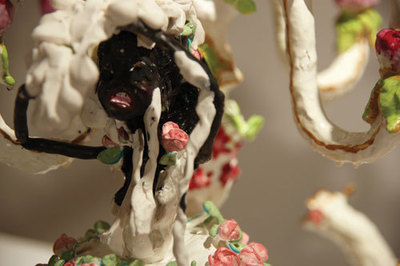
I Found Myself Alone puts a spindly black ballerina on a table set for afternoon tea. She dances awkwardly between creamy confections and baroque crockery before being doused by wax from a candle. She cleans herself of the goop after a struggle, but soon faces a second attack. Eventually, she seeks revenge on whiteness by using coffee from the pot to stain the linen and porcelain. The battle between black and white gestures to histories of colonialism and immigration, but any moral drawn from the narrative is as discomfiting as the work itself becomes beyond its cutesy opening moments. Djurberg's use of the tactility of plasticine and her partner Hans Berg's eerie musical score make I Found Myself Alone fascinating to watch.


The Mumbai Art Room is situated bravely on the ground floor of a large residential building, and news has got round about the entertainment on offer inside. Students of the Navy Children School next door are regular visitors. In the short time I spent in the gallery, four girls and then five boys walked up to the glass doors, peered inside for a minute, before entering, sitting themselves on the floor, giggling and whispering loudly, and being shushed by the gallery manager. It's good to see this connection with the neighbourhood, which is obviously something Susan Hapgood wants to take further. It does, of course, restrict the kind of art she can show. I can't imagine, for instance, that Nathalie Djurberg's more graphic stuff would be welcomed in this location.
Here's a portion of a video by Djurberg screened at the 2009 Venice Biennale, where she won the Promising Young Artist award. It's reminiscent of Salvador Dali's canvases Premonitions of Civil War and Autumnal Cannibalism, which must have been as disturbing in their time as Djurberg's work is in ours.